



Cross-Border Service Taxation Challenges: Market Jurisdiction‘s View
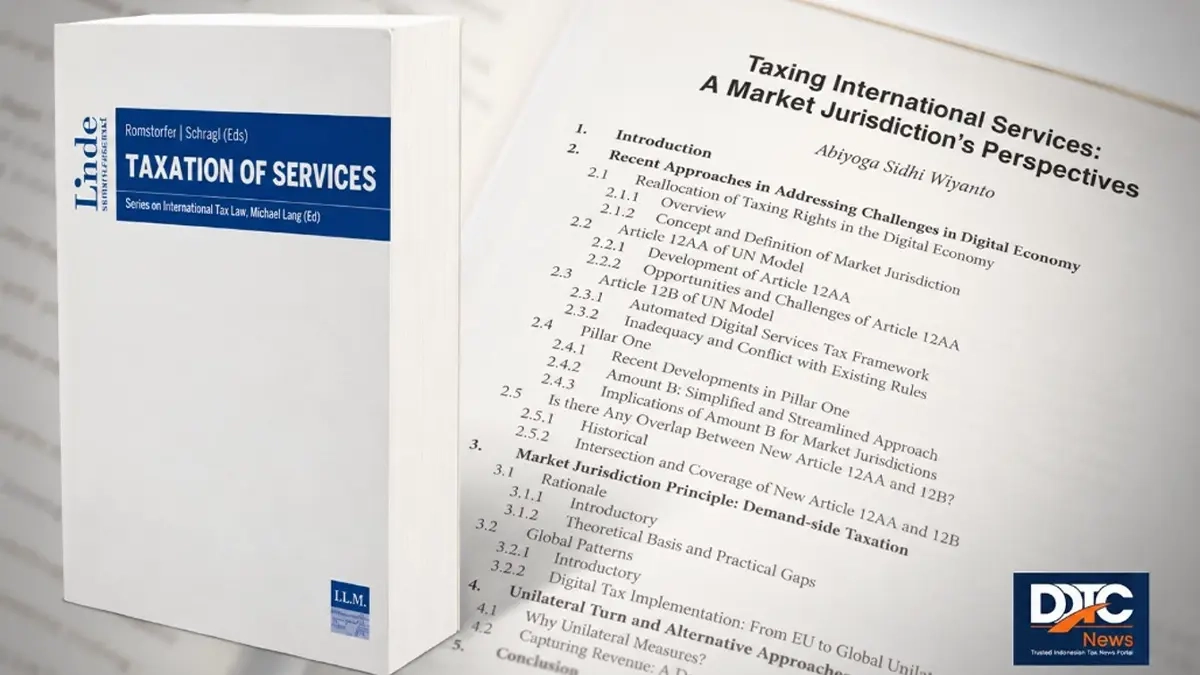
COMPANIES can now derive income from a country without maintaining an office there. Consumers enjoy services, transactions take place and economic value is created. Yet the right of the market jurisdiction to tax that income remains a matter of debate.
This is the central thread of the article by Tax Expert, CEO Office of DDTC, Abiyoga Sidhi Wiyanto, entitled Taxing International Services: A Market Jurisdiction's Perspectives. From the perspective of the market jurisdiction, Abiyoga examines the direction of international tax reform and the capacity of various approaches to address the challenges of taxing cross-border services.
The article also brings together a discussion of the UN Model, Pillar One and unilateral policy measures through one fundamental question: how does a market jurisdiction obtain a fair share of taxing rights?
In this edition, Abiyoga joins contributors from 19 other countries, including the United States (US), Brazil, Bolivia, Chile, Colombia, Ghana, India, Italy, Japan, Germany, Malta, Mexico, Panama, France, Peru, Portugal, Spain and Taiwan.
The Market Jurisdiction's Contribution to Value Creation
A market jurisdiction is the jurisdiction in which the consumer is located. In the digital economy, this jurisdiction can be a source of income for a foreign company even though the service provider does not have a permanent establishment (PE) in the market jurisdiction.
According to Abiyoga, recognition of the market jurisdiction rests on the contribution of demand to value creation. People's purchasing power, user participation and the availability of public infrastructure all support a company's income. These contributions form the basis for reassessing the allocation of taxing rights between countries.
This paradigm goes beyond a discussion that has historically focused more on the distinction between developed countries and developing countries. Market size, tax administration capacity and revenue requirements all shape each country's policy choices in responding to digitalisation.
This discussion became even more relevant after the 2025 edition of the United Nations Model Tax Convention was officially published on 28 August 2026. This update provides concrete context for the analysis of the expansion of taxing rights over services.
One of the principal changes is the introduction of Article 12AA on fees for services. This provision replaces Article 12A on fees for technical services and Article 14 on independent personal services, with a broader scope covering service fees. The source country may tax covered service fees without requiring the existence of a PE of the service provider.
Abiyoga also discusses Article 12B of the UN Model on income from automated digital services. This provision targets services delivered via the internet or an electronic network with minimum human involvement on the part of the provider.
In this regard, he highlights the challenges of distinguishing automated services from services requiring human involvement. Collecting tax on payments from individual consumers also presents practical difficulties. Accordingly, the simplicity of a withholding tax design does not necessarily mean simplicity in its implementation.
A further challenge is the impact of taxing gross amounts. Tax is calculated on service fees, implying that providers with thin margins may face a proportionately heavier burden. The risk of double taxation is also a concern in assessing the effectiveness of this policy's implementation.
Unilateral Policy Options
Abiyoga then examines digital services tax (DST) and unilateral policy measures as a response when resolution through multilateral agreements such as Pillar One and other multilateral forums remains elusive. In this context, unilateral measures are positioned as interim instruments to safeguard revenue and assert the fiscal interests of the market jurisdiction.
However, unilateral instruments are not without risks. Differences in design between countries can increase uncertainty, the risk of double taxation, and even political tensions. The tax burden may ultimately be passed on to consumers. Unilateral measures such as DST therefore need to be considered carefully and with due caution.
Ultimately, the updates in the UN Model 2025 also provide a new reference point for tax treaty negotiations. However, their application continues to depend on domestic provisions and the terms of the applicable tax treaty.
For policy makers, practitioners and academics, this contribution offers materials for assessing the direction of service taxation following the publication of the UN Model 2025.
The central question remains the same: to what extent can updated rules generate a fair share of revenue for the market jurisdiction whilst preserving certainty for cross-border business activities?
DDTC's Contribution to International Taxation
As information, prior to the book Taxation of Services, several other DDTC professionals have also contributed to international tax books of accounts. One such example is DDTC Founder Darussalam in the book A Global Analysis of Tax Treaty Disputes.
Several other international tax books of accounts featuring contributions from DDTC professionals include the Transfer Pricing Law Review, The Tax Disputes and Litigation Review, Implementing Key BEPS Actions: Where Do We Stand?, Controlled Foreign Company Legislation, The Implementation and Lasting Effects of the Multilateral Instrument, Justice, Equality and Tax Law, Mandatory Disclosure Rules and Mobility of Work. There are also a variety of other international publications.
A number of these international publications featuring contributions from DDTC professionals also arose from the apprenticeship process through coursework, training or global-level conferences. DDTC professionals' participation in these various activities forms part of the Human Resource Development Programme (HRDP).
Each year, through the HRDP, DDTC awards unconditional scholarships to its professionals to participate in various tax competency development programmes. These opportunities encompass training through to formal undergraduate and postgraduate education at leading institutions and universities, both domestically and abroad.
With regard specifically to apprenticeship abroad, DDTC professionals have to date studied in 20 countries. The HRDP represents a concrete expression of one of DDTC's missions, namely investing in human resources. This commitment simultaneously supports DDTC's vision of becoming a tax institution grounded in research, technology and knowledge that sets the standards and beyond. (rig)