



Hard-to-Value Intangibles: Transfer Pricing Challenges

SINGAPORE, DDTCNews – Transfer pricing analysis of Hard-to-Value Intangibles (HTVIs) is considered to pose unique challenges owing to the limited availability of reliable comparables and the high degree of uncertainty surrounding the economic benefits to be generated in the future.
This was one of the topics addressed in materials presented by Adam Henderson, Partner, Financial Services Transfer Pricing, Ernst & Young Solutions LLP, at the WU-TA Advanced Transfer Pricing Programme 2026 in Singapore.
From a transfer pricing perspective, HTVIs refer to assets or rights over intangibles for which no reliable comparables exist, and which carry a high degree of uncertainty when projecting future cash flows at the time the transaction is undertaken.
This situation renders the valuation of intangibles considerably more complex. The limited availability of reliable comparables means that HTVI pricing relies on various assumptions regarding the potential economic benefits that may be generated in the future.
According to Adam Henderson, there are 2 key points to consider when identifying HTVIs: the unavailability of reliable comparables and the high degree of uncertainty.
These characteristics may be found in intangibles that are still at the development stage, are yet to be exploited in the future, are unique in nature or have no established commercial track record. Examples include gene therapy platforms, pre-launch software platforms and new brands entering emerging markets.
The level of uncertainty associated with HTVIs may arise from various post-transaction developments. An intangible may experience successful commercialisation, delays, development failure, the emergence of competitors, price changes, or shifts in market conditions.
Accordingly, the valuation of HTVIs should not consider only a single scenario, but also a range of outcomes that could realistically occur. In this regard, probability weighting may be used to reflect the likelihood of success across various stages of development or commercialisation.
When determining an arm's length price, the information used must be based on the conditions and information available at the time the transaction was undertaken or the price was set. This approach is known as ex-ante.
Such information may include business forecasts, estimates of the time to commercialisation, probability of success, market conditions and the potential for competitive developments. For taxpayers, this approach also underscores the importance of establishing an adequate audit trail from the time the transaction is undertaken.
Meanwhile, actual information that only becomes known after the transaction cannot always be regarded as information that was realistically available when the initial price was determined.
An ex-post approach may be used as a sense check against the reasonableness of assumptions in the ex-ante analysis, but should not automatically serve as the basis for hindsight pricing.
Any difference between actual outcomes and initial projections must be analysed to ascertain whether those developments could in fact have been predicted at the time the transaction was undertaken or whether they constitute events that could not reasonably have been foreseen.
Consequently, if actual outcomes prove to be materially higher or lower than initial estimates, such a situation does not in itself indicate that the previous transaction price failed to satisfy the arm's length principle (ALP).
Coordination Across Various Functions Within the Company
A further implication for taxpayers is the need for coordination across various functions within the company before the transaction is undertaken.
The research and development function can provide information on technical developments, testing stages, and probability of success. The finance function, meanwhile, can supply forecasts, profitability estimates, and valuation analysis.
Management can explain the commercial strategy and rationale for the transaction, whilst the legal and tax functions must ensure that the analysis is consistent with the relevant agreements and the rights and obligations of the parties involved.
A cross-functional approach is important because the information required to assess HTVIs is generally not available solely within the tax function.
With regard to Singapore, the OECD provides guidance on the treatment of HTVIs in that jurisdiction, including the period during which a transaction may still be reviewed by the tax authority.
Singapore applies a 5-year period for such reviews. In cross-border transactions involving HTVIs, taxpayers must therefore be attentive to differences in the rules between jurisdictions, as these may affect the review period and post-transaction risks.
The identification of HTVIs should be conducted after the intangibles have first been accurately delineated. The analysis should not proceed directly to pricing, but should begin by determining the intangibles being transferred or licensed, their characteristics, the rights granted and their economic conditions.
It should then be analysed whether there is a lack of reliable comparables and a high degree of uncertainty regarding the economic performance of the intangibles. The identification and delineation of the transaction thus forms the foundation before any valuation analysis is conducted.
Given the high degree of uncertainty, the compensation structure for HTVIs may be designed to accommodate developments in economic value following the transaction. In addition to lump-sum payments, mechanisms such as milestone payments, earn-outs, success-based payments or price adjustment/re-opener clauses may be employed.
For example, additional payments may be linked to the achievement of specific milestones, such as the successful completion of clinical trials or the receipt of regulatory approval. Such mechanisms allow compensation to reflect economic developments whilst allocating the risk of uncertainty between the party transferring and the party receiving the intangibles.
Ultimately, the central issue in HTVI transactions is the taxpayer's ability to demonstrate that the price set was supported by reasonable information and assumptions at the time the transaction was undertaken.
Accordingly, transfer pricing documentation should cover the basis for pricing, financial forecasts, valuation assumptions, risk analysis, realistically available alternatives and information obtained from the relevant functions.
Subsequent ex-post developments may then be used to test the reasonableness of the ex-ante approach, whilst maintaining a clear distinction between developments that could reasonably have been predicted and those that were unforeseen.
This approach may provide an adequate basis should the HTVI pricing subsequently be reviewed by the tax authority.
Report from Singapore
For reference, this report was written by DDTC Consulting Specialist Reeza Aldila Rajab, who is attending the WU-TA Advanced Transfer Pricing Programme 2026 in Singapore. The programme is held from 28 September to 1 October 2026.
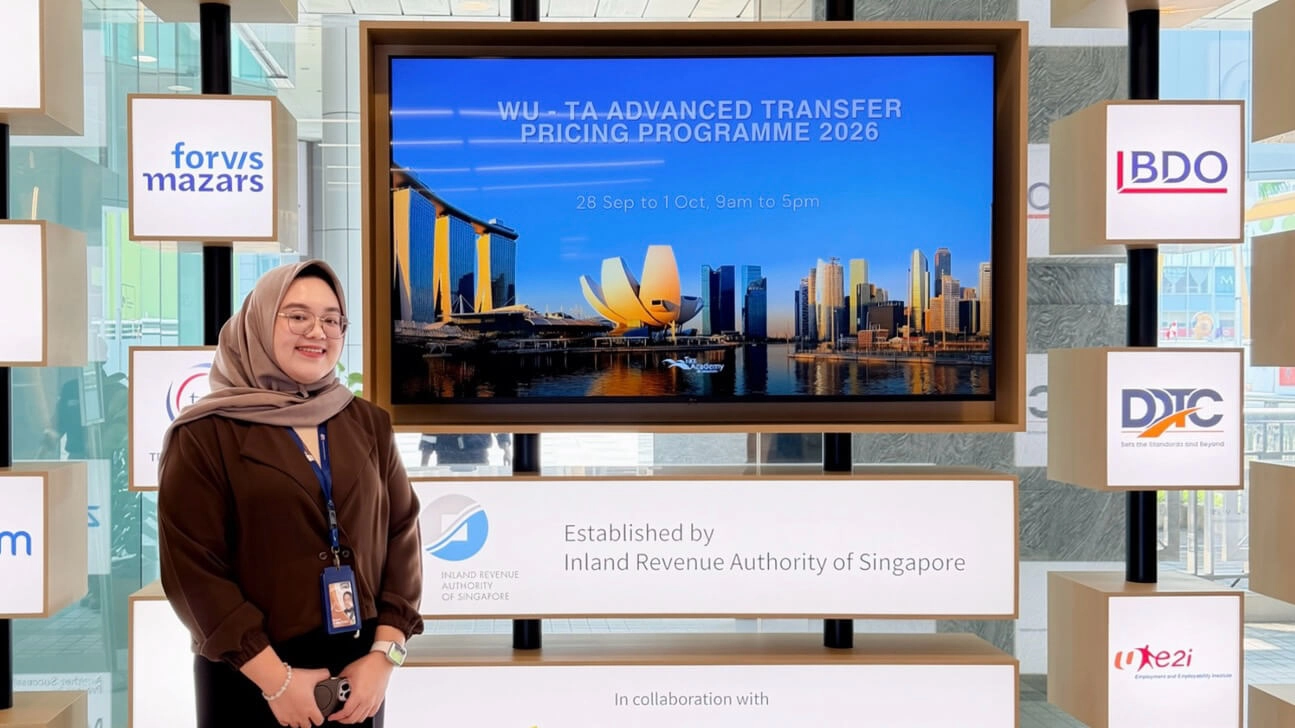
In addition to Reeza, 5 other DDTC professionals are participating in the programme. Their participation forms part of the Human Resource Development Programme (HRDP) run by DDTC.
Through this programme, DDTC provides its professionals with the opportunity to develop their competencies through various training programmes, both domestically and abroad. All costs associated with participation in this programme are borne by DDTC with no service bond attached.
DDTC Founder Darussalam, who is also one of Indonesia's leading tax experts, stated that DDTC professionals' participation in the programme is aimed at strengthening their understanding of international developments and practices in transfer pricing.
In his view, the knowledge and perspectives gained from international training can support DDTC professionals in handling a wide range of transfer pricing issues and in delivering services and advisory to clients to a standard that exceeds expectations.
Participation in this international training programme also forms part of DDTC's commitment to continued investment in its human resources. This investment is carried out through various competency development programmes, including professional training and the award of scholarships to leading universities worldwide.
This commitment is in line with DDTC's vision of becoming a research-, technology- and knowledge-based tax institution that sets the standards and beyond. (rig)