



Building Legal Consistency via a Tax Chamber at the Supreme Court

This article draws from the author's books entitled Lembaga Peradilan Pajak di Indonesia: Persoalan, Tantangan, dan Tinjauan di Beberapa Negara (2023) and ajian Persiapan Penyatuan Atap Pengadilan Pajak: dari Kementerian Keuangan kepada Mahkamah Agung (2025), published by DDTC. This article specifically discusses the agenda following the unification, namely building consistency in decisions and unity in the application of tax law through a Tax Chamber at the Supreme Court (SC).

THE unification of the tax court under a single roof is about to enter a decisive phase. Pursuant to the Constitutional Court Decision Number 26/PUU-XXI/2023, the organisational, administrative and financial guidance of the tax court must be transferred from the Ministry of Finance (MoF) to the Supreme Court (SC) no later than 31 December 2026.
This transfer will resolve one of the issues that has long shadowed the tax court, namely the dualism of guidance, which has frequently been questioned in relation to the independence of the tax court.
However, the unification of the tax court under the SC should not become the final point of tax court reform. The next agenda should focus on more substantive matters, namely developing the professional expertise of judges and building consistency in decisions and unity in the application of tax law. In this way, tax law decisions produced will become common sense and a mirror for all parties.
In that context, the role of the Supreme Court (SC) is crucial. Tax court decisions are indeed final decisions and carry permanent legal force. However, against such decisions, a civil review (peninjauan kembali/PK in Indonesian) may still be filed with the SC. This implies that the SC holds a strategic position in shaping consistency in decisions and unity in the application of tax law.
The existence of consistency in decisions and unity in the application of tax law is in fact already aligned with the philosophy of the chamber system at the SC. The chamber system within the SC was first applied on 19 September 2011 pursuant to SC Chief Justice Decree Number 142/KMA/SK/IX/2011. That system subsequently underwent a number of adjustments, including through SC Chief Justice Decree Number 213/KMA/SK/XII/2014.
The SC states that the chamber system has three objectives. First, to maintain unity in the application of law and consistency in SC decisions. Second, to enhance the professionalism of Supreme Court Justices. Third, to accelerate the process of resolving cases or disputes. The chamber system guidelines also state that the establishment of chambers at the SC takes into account the volume of cases or disputes, which is consistent with the views of Wendy L. Hansen, Renee J. Johnson, and Isaac Unah (1995) as well as the need for specialised expertise among Supreme Court Justices, which is also in line with the views of Isaac Unah and Ryan Williams (2018).
Based on the foregoing, the urgency for a Tax Chamber system at the SC to build consistency in decisions and unity in the application of tax law finds its justification. Michael D'Ascenzo, in Taxation Law Design (2002), uses the term a coherent body of tax law when explaining the foundation of a sound tax system. According to him, a tax system that is more certain, fair and sustainable requires a body of tax law that is coherent, clear, certain and consistent.
Consistency in decisions and unity in the application of tax law certainly does not imply that every dispute must produce the same outcome. The facts of each dispute may differ, regulations may change and developments in business and economic activity may give rise to new issues. Tax courts may also develop or alter legal interpretation when there are compelling reasons to do so. This is precisely where the role of the Tax Chamber system at the SC lies, namely to steward the dynamic changes in the tax law landscape going forward.
The following sets out in greater detail the justification for establishing a Tax Chamber institution at the SC.
Tax Disputes Dominate the State Administrative Chamber at the SC
The facts show that tax disputes dominate the disputes handled by the State Administrative Chamber (Tata Usaha Negara/TUN in Indonesian). Of the five chambers at the SC, the TUN Chamber was the chamber with the second largest volume of disputes in 2025, sitting below the Criminal Chamber. However, what is more notable is the composition of disputes therein. Tax disputes constitute the majority of disputes entering the TUN Chamber.
Based on the SC Annual Report 2025, throughout 2025 there were 8,606 new disputes lodged with the TUN Chamber, representing an increase of 15.07% (year-on-year). With 135 disputes carried over from the previous year, the total caseload of the TUN Chamber reached 8,741 disputes. Of that number, 8,712 disputes were decided, leaving only 29 disputes outstanding at year-end.
Of the new disputes lodged, 7,500 were civil review applications against tax court decisions. This implies that, in terms of the number of disputes received, approximately 87.1% of disputes received by the TUN Chamber were tax disputes, with only 12.9% being non-tax disputes (TUN cassation, TUN civil review, judicial review applications and electoral administrative violation disputes).
With that composition, tax disputes clearly dominate the disputes entering the TUN Chamber. Simply put, nearly 9 out of every 10 new disputes in the TUN Chamber in 2025 were civil review applications against tax court decisions.
The large volume of tax disputes is also evident at the tax court level. Throughout 2025, the tax court received 15,348 new disputes. With 8,044 disputes carried over from the previous year, the total caseload reached 23,392 disputes. Of that number, 15,333 disputes were decided and 100 disputes were withdrawn, leaving 7,959 disputes outstanding at year-end.
These figures demonstrate that tax disputes involve an exceptionally large scale of processing at both levels of adjudication. The tax court receives more than 15,000 new disputes per year. At the SC level, approximately 7,500 tax civil review applications were lodged, accounting for 87.1% of all new disputes in the TUN Chamber.
However, the sheer number of tax disputes is not in itself the sole reason for establishing a Tax Chamber. The volume of disputes is more appropriately understood as one important indicator that reflects the extent of the need for dispute management based on institutional capacity and professional expertise.
The more fundamental consideration lies in the nature of tax disputes themselves, namely thousands of disputes that each year generate various interpretations and applications of tax regulatory provisions to highly diverse facts.
This is where the urgency for a Tax Chamber system lies. Thousands of tax decisions are not merely statistics on dispute resolution; they also embody an accumulated body of tax law knowledge concerning how tax norms are interpreted, applied, distinguished, and developed.
The question is not only how promptly disputes can be resolved, but also what can be produced from thousands of such decisions for the development of tax law in Indonesia.
Comparative Models of Tax Dispute Resolution at the SC Level in Other Countries
The experience of other countries shows that the resolution of tax disputes at the SC level does not take a single form. The Netherlands, France and Germany are instructive comparisons not because any one of them can serve as a model for Indonesia, but because all three demonstrate different ways of institutionalising tax disputes at the SC level. Yet their commonality is that tax disputes at the SC level are adjudicated and decided by institutions and parties that are already specialised and professional.
In the Netherlands, there is a general Supreme Court known as the Hoge Raad. The Dutch Supreme Court has its own Tax Chamber (belastingkamer). This Tax Chamber adjudicates and decides tax disputes and has its own judges and advocates-general who are not shared with other chambers.
In France, there is a separate Supreme Court for adjudicating and deciding administrative disputes (the Administrative Supreme Court or Conseil d'État). This is therefore not a general Supreme Court as in the Netherlands. Tax disputes are handled by Chambers 8 and 9 of the 10 chambers within that Administrative Supreme Court.
In Germany, there is a standalone specialist tax Supreme Court for adjudicating and deciding tax disputes, known as the Bundesfinanzhof. This specialist tax Supreme Court is not a Tax Chamber within a Supreme Court, but rather one of five Federal Supreme Courts in Germany.
For greater clarity, the models of tax dispute resolution through the court system in those three countries can be seen in the Figure below.

The Need for a Tax Chamber within the State Administrative Judiciary at the SC
The institutionalisation of tax disputes at the SC level through a Tax Chamber need not be understood as an attempt to separate tax law from administrative law. The aspect that needs to be maintained is the extent to which tax disputes that have already been specialised at the tax court still need to continue to be handled in a specialised manner when those disputes reach the SC level.
The Tax Chamber system under that design is not a new judicial environment. Tax disputes remain within the State Administrative Judiciary; their fundamental character as public law disputes does not change and their relationship with administrative law is not severed. What changes is that tax disputes are resolved in a Tax Chamber established within the SC's State Administrative jurisdiction. This can be seen more clearly in the Figure below.
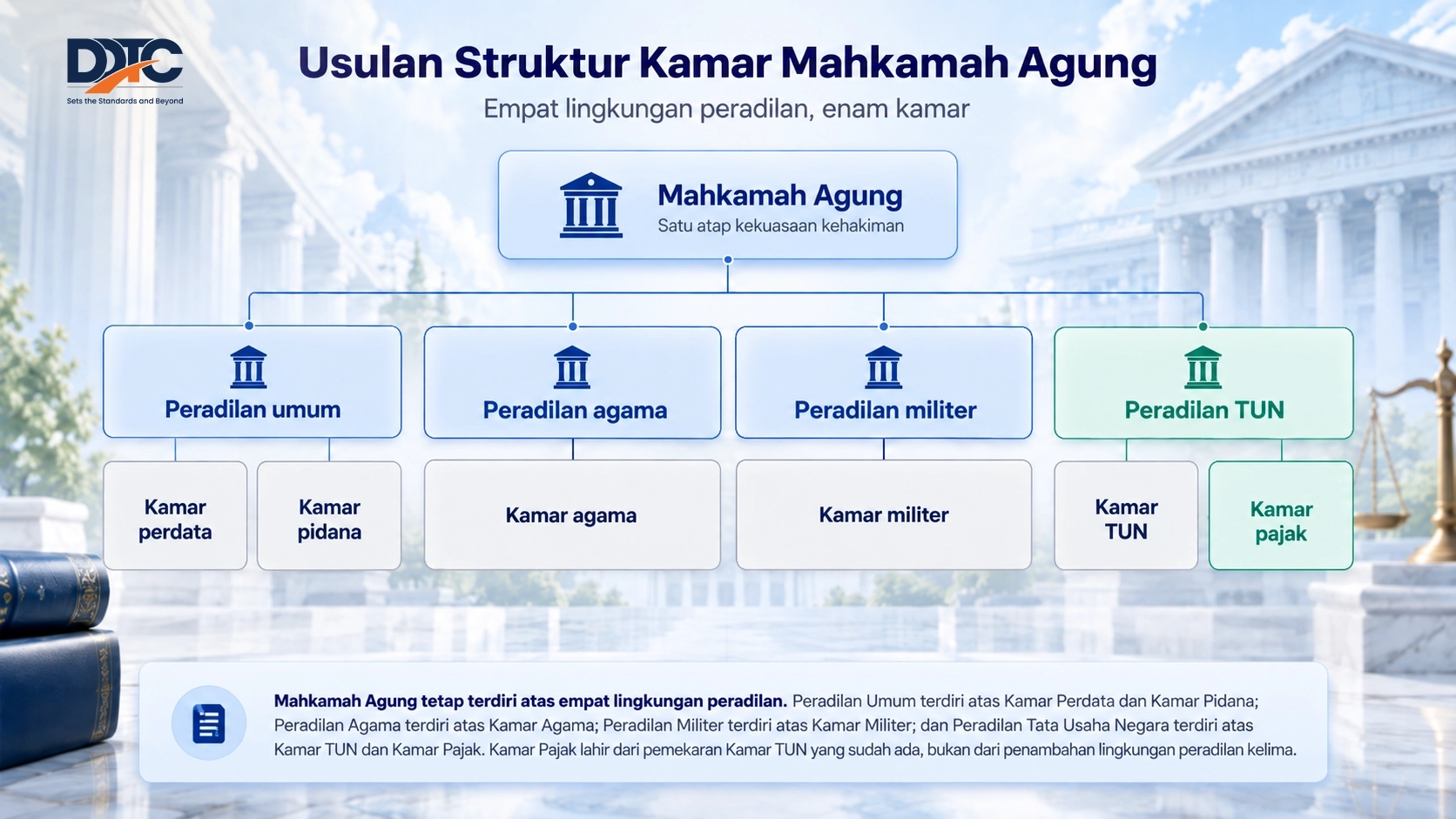
Therefore, if a Tax Chamber is chosen, its design must simultaneously take into account the need for safeguards. For example, a plenary mechanism when issues intersect with other chambers, transparency and access to decisions, supervision mechanisms, continuing education, knowledge exchange and room to involve expertise from outside tax law when genuinely required.
Consistency in Decisions and Unity in the Application of Tax Law — for Whose Benefit?
The benefits of consistency in decisions and unity in tax law do not stop at the SC's internal interests. For taxpayers, increasingly clear consistency in decisions and unity in the application of tax law provides a better basis for understanding the tax implications of a business transaction and will reduce the cost of compliance.
For tax consultants and attorneys, consistency in decisions and unity in the application of tax law serves as a guide for providing advice, constructing arguments and assessing whether a dispute genuinely warrants continuation or discontinuation.
For the government, consistency in decisions and unity in the application of tax law can serve as a reference for maintaining administrative consistency whilst also providing feedback on regulations. Issues whose tax law position is sufficiently settled need not continually become an arena for the same debates. Resources can be directed more effectively towards compliance risks, new transactions and legal issues that are genuinely still open or more strategic in nature.
For the tax court, consistency in decisions and unity in the application of tax law results in a reduction of recurrent disputes that arise primarily from uncertainty in interpretation and opens space to devote greater attention to disputes involving new, complex or strategic legal issues.
Thus, it can be said that the Tax Chamber is an instrument; its purpose is to build consistency in decisions and unity in the application of tax law, with tax legal certainty as its ultimate benefit.