



Tax Court Transferred to Supreme Court; Attorney Rules Unchanged
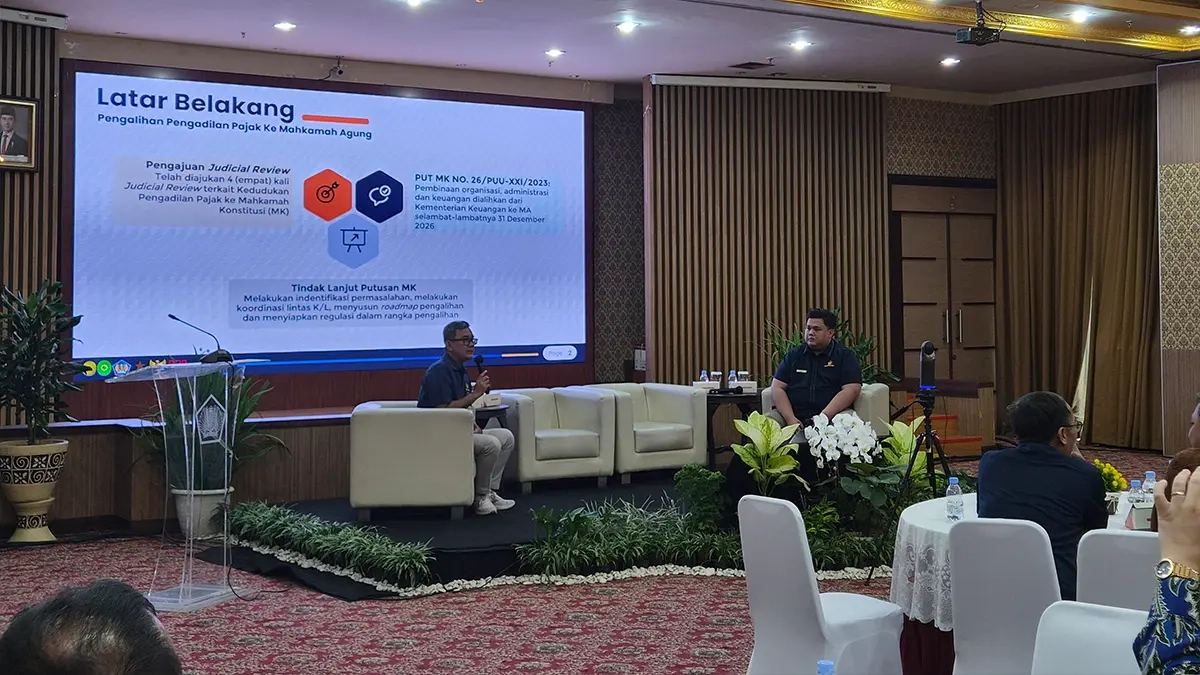
JAKARTA, DDTCNews - The transfer of authority over the organisational, administrative and financial guidance of the Tax Court from the Ministry of Finance (MoF) to the Supreme Court does not alter the provisions on the requirements for attorneys at the Tax Court.
Substitute Registrar of the Tax Court Secretariat, Aditya Agung Priyo Nugroho, stated that the requirements to become an attorney at the Tax Court will continue to follow the provisions set out in the minister of finance regulation (MoF Reg.).
"With regard to attorneys, up until the transfer in 2027, the existing provisions will apply. We will use attorneys pursuant to the applicable minister of finance regulation," said Aditya at the meaningful participation session on the Draft Presidential Regulation (Draft Pres. Reg.) on the Transfer of Organisational, Administrative and Financial Guidance of the Tax Court from the MoF to the Supreme Court, on Wednesday (23/9/2026).
Not only based on the minister of finance regulation, Article 32 of Law 14/2002 on the Tax Court also stipulates that guidance of attorneys at the Tax Court is carried out by the chief justice of the tax court.
The provisions contained in the Tax Court Law remain in force, given that to date, no law has been enacted to revise the Tax Court Law.
"This law has not been revised. We will use those provisions. In case of amendments to the law, we will of course also inform the attorneys. So those appearing before the Tax Court will likely face the same situation in 2027," said Aditya.
As contained in the transitional provisions of the draft presidential regulation currently being prepared, dispute-handling procedures will continue to refer to the Tax Court Law insofar as the said law has not been revised by the government and the House of Representatives as the law-making body.
"If there are amendments, the law must first be revised. The process of revising a law takes time. For a law, the public consultation is more proper and attorneys will certainly be invited and can provide input, given that their competencies may differ from those of advocates in general," said Aditya.
The Tax Court's authority to guide attorneys is contained in Article 32 of the Tax Court Law. The said article affirms that the Tax Court is authorised to supervise attorneys providing legal assistance to the disputing parties.
"Supervision referred to in paragraph (1) shall be further regulated by a Chief Justice Decree," reads Article 32 paragraph (2) of the Tax Court Law.
There are several requirements that must be met in order to become an attorney at the Tax Court, as set out in Article 34 paragraph (2) of the Tax Court Law, namely:
- an Indonesian citizen;
- having extensive knowledge and expertise in statutory tax provisions;
- fulfilment of other requirements determined by the minister.
Referring to MoF Reg. 184/2017, broad knowledge and expertise in tax regulations may be evidenced by a Bachelor's degree (S-1) or a four-year Diploma (D-IV) in fiscal administration, accounting, taxation and/or customs and excise from an accredited university.
If the attorney does not hold a degree in the above fields, knowledge and expertise in the field of taxation may be evidenced by an S-1 or D-IV degree together with:
- a three-year Diploma (D-III) in taxation and/or customs and excise from an accredited university;
- tax training/course;
- a customs and excise proficiency certificate from a government agency or customs and excise education and training institution; or
- a letter or document demonstrating experience of having worked at a government agency in the technical field of taxation and/or customs and excise.
For information, the regulation regarding the requirements to become an attorney at the Tax Court is also one of the topics discussed in the book authored by DDTC and LeIP entitled Kajian Persiapan Penyatuan Atap Pengadilan Pajak dari Kementerian Keuangan Kepada Mahkamah Agung.
In general, the Supreme Court will need to regulate the requirements and competencies for legal attorneys as well as the procedures for granting attorney licences, in line with the consolidation of the Tax Court under its jurisdiction. However, the new requirements will not apply retrospectively to legal attorneys who are already licensed.
"In other words, attorneys who obtained their attorney licence before or during the transitional period will not be affected by the new provisions on the requirements to become an attorney and the granting of attorney licences following the consolidation of the Tax Court under the Supreme Court," reads a passage from the said publication.
DDTC Founder Darussalam has also previously stated that the consolidation must provide legal certainty for attorneys who do not hold a law degree. This is particularly pertinent given that the majority of attorneys are not law graduates.
"The reality is that most of those who become attorneys are not law graduates. We come from accounting disciplines and study tax law materials," said Darussalam in April 2025.
If the Supreme Court establishes new requirements for attorneys, those requirements should not apply retrospectively to those who already hold an attorney licence prior to the consolidation.
Even if attorneys at the Tax Court are eventually required to hold a law degree, that requirement should ideally only apply to those who apply for a licence after the consolidation has taken effect. (rig)