



Appraiser Credentials in Valuation Reports: Singapore‘s Standards

SINGAPORE, DDTCNews - “Putting two valuers in a room will never yield the exact same figure.”
This statement was one of the key points discussed at The Integrated IP, Valuation & Tax (IIVT) Course for Decision-Makers, held in Singapore. The programme covered a range of topics, from the fundamentals of intangible asset valuation and valuation standards and application, to regulatory frameworks, taxation, and dispute resolution.
Speakers at the programme included Partner in Valuation, Modeling, and Economics at EY Singapore, Chua Ai Ling; Partner in Valuation and Financial Advisory at Deloitte Singapore, Leonard Wu; Partner in the Valuation Practice at PwC Singapore, Christopher Tan; Master Tax Specialist in Intellectual Property at the Inland Revenue Authority of Singapore (IRAS), Richard Koh; and Head of Enterprise and Ecosystem at IPOS International, part of the Intellectual Property Office of Singapore, Fu Zhikang.
Valuation: An Art Backed by Science
Valuation can be viewed as an art backed by science.
Although it relies on financial models, formulae and figures, the results of a valuation calculation must nonetheless make practical sense from a business perspective. Valuation is complex because it requires projections of future cash flows, estimates of discount rates, and the determination of the useful life of an asset.
Nevertheless, valuation remains an important element of various business activities. It is required in merger and acquisition transactions, corporate restructuring and crowdfunding, the preparation of financial statements, tax purposes and dispute resolution and litigation.
Specifically for tax purposes, in Singapore, valuation is required when a company claims writing-down allowances for transfers of assets of intangible property under Section 19B of the Singapore Income Tax Act.
Valuation is also required to substantiate the arm's length price when a company undertakes controlled transactions involving transfers of assets of intangible property, licensing or corporate restructuring. Such valuation is necessary for the company to demonstrate to the tax authority that the transaction has been conducted according to the arm’s length principle (ALP).
In addition, valuation is required where there is a cross-border transfer of assets that triggers a capital gains tax liability or exit tax liability in another jurisdiction.
Valuation Standards in Singapore
In Singapore, valuation standards are governed by the IVAS (Institute of Valuers and Appraisers Singapore) standards. These standards aim to ensure that valuation reports are internationally aligned with the International Valuation Standards (IVS) issued by the International Valuation Standards Council (IVSC).
Specifically for tax purposes, the Inland Revenue Authority of Singapore (IRAS) has also established guidelines on valuation, particularly in the context of tax claims under Section 19B. The most recent update to these guidelines was released in early 2026.
A valuation report submitted in support of a claim under Section 19B must contain, at a minimum, the company's business background and value drivers, the valuer's credentials, the valuation date, the definition of value and any disclaimers and limitations where applicable.
The report must also set out the information used in determining the valuation, material risks, the purpose of the valuation, the terms of the contractual engagement and the type of intangible property being valued. In addition, the report must include the valuation approach and methodology, valuation assumptions and inputs and the valuation conclusion.
This raises an important question: if the applicable standards and reporting requirements have already been established, why can valuation results still differ?
In theory, valuation calculations for tax, transfer pricing, accounting and business purposes should be consistent when the same data and facts are used.
In practice, however, valuation results can differ significantly and, in some cases, substantially. It is therefore important to understand that the same asset or business may have different values depending on how it is used and the purpose for which the valuation report is prepared.
One particularly noteworthy aspect of Section 19B is the requirement to disclose the credentials of the valuer preparing the valuation report.
This is important because a valuer’s credentials can contribute to the credibility of the valuation report. Accordingly, it is essential to ensure that the individual or firm preparing the report has the appropriate expertise and capabilities to undertake the valuation assignment.
In practice, differences in the quality of valuation reports remain a concern in Singapore. There is a discernible difference in quality between valuation reports prepared by appraisers holding the Chartered Valuers and Appraisers (CVA) professionals and those prepared by non-CVA practitioners. Similar differences may arise in reports prepared overseas. Although such reports may satisfy the professional standards applicable in their home jurisdictions, they may not necessarily satisfy the requirements or expectations applicable in Singapore.
These differences in quality are particularly significant because valuation involves the construction of financial models that rely heavily on assumptions.
“It depends” is a common initial response from valuers when asked to estimate the value of an asset or business.. This is because an asset or business does not have a fixed and universal monetary value.
The final figure in a valuation report depends heavily on various factors, most notably the valuer's experience and the perspective adopted. is a common initial response from valuers when asked to estimate the value of an asset or business.
Communicating a valuation report also presents its own challenges. Differences in terminology and professional perspectives among legal professionals, valuers, accountants and tax professionals can complicate the communication process. Each party has its own “language” and often works in silos.
In practice, tax profession also tends to develop its own definitions and frameworks. One example is the definition of intangible assets, which can have a direct impact on the valuation process.
Bridging these differences in perspective is essential to ensure that valuation reports can be understood, evaluated, and defended from multiple professional and regulatory perspectives.
Reducing Disputes: The Importance of Valuer Credentials
Tax people being tax people. In practice, tax matters are viewed primarily from a tax perspective. This can create a disconnect with the perspective of the business world.
One example relates to the concept of hindsight or the use of information about events that occurred after the valuation date to assess an earlier transaction.
In valuation practice, hindsight should not be used to determine value as at a historical valuation date. A valuation should reflect the information and circumstances reasonably available as of that date. Tax authorities, however, may examine a transaction 3 to 5 years after it has taken place.
The tax authority may subsequently use actual historical performance to assess whether the assumptions in the original valuation were unreasonably optimistic or pessimistic.
Beyond differences in timing, the parties may also adopt different points of view.
Valuation reports prepared by general valuation practitioners may adopt the perspective of a typical market participant or industry participant. The tax authority, by contrast, may focus more closely on the specific circumstances of the parties actually involved in the transaction.
For example, in a controlled transaction involving a restructuring, the tax authority will examine the specific objectives of the party undertaking the restructuring, rather than relying solely on general industry trends. Given these differences, disputes over valuation outcomes are entirely possible.
One major dispute that attracted attention involved Facebook and the US Internal Revenue Service (IRS), with proceedings and reporting extending into 2025. The dispute concerned the appropriate valuation methodology, including the Residual Profit Split Method versus a one-sided method, in connection with an exit tax arising from the transfer of intangible assets.
In the dispute, Facebook valued its business at USD6 billion, whereas the IRS valued it at USD120 billion.
To avoid valuation disputes such as the example above, taxpayers and valuation professionals must understand the business and commercial context underpinning the transaction. Valuation assumptions must be based on relevant business conditions and supported by appropriate information that accurately reflects the actual state of the business at the time of valuation.
It is also important to recognise that valuation reports may differ depending on their intended purpose. Companies sometimes make the mistake of reusing a single valuation report across different contexts without reassessing its suitability. Consideration must be given to whether a valuation report prepared for financial reporting purposes, such as a Purchase Price Allocation (PPA), crowdfunding, or restructuring, can be used directly for tax purposes, for example, for Section 19B claims or transfer pricing.
The tax authority applies different definitions and reporting standards. As a result, a report originally prepared for another purpose may be rejected when used for tax purposes and ultimately result in a tax adjustment.
As noted above, there is a quality gap in valuation reports that depends on the quality of the appraisers. It is therefore important to comply with official valuation standards and guidelines.
Engaging qualified and appropriately credentialed professionals who adhere to recognised valuation standards, including a “comply or explain” approach where applicable, is strongly recommended. Taxpayers should also avoid relying on inadequately prepared reports that merely seek to satisfy formal compliance requirements, including reports generated with the assistance of artificial intelligence (AI) that are unable to withstand scrutiny by the tax authority.
To ensure the quality of the valuation process, the involvement of various parties with different backgrounds should also be encouraged from the outset, not merely when the valuation process commences, but from the point at which a business decision is to be made.
This is where valuation, transfer pricing, taxation, and other disciplines intersect. Each discipline offers a different perspective for assessing the implications of a business decision or restructuring.
Ultimately, integrating these perspectives helps ensure that business decisions are legally defensible, strategically sound and capable of creating additional value.
In an environment where global standards are increasingly converging, such integration is no longer merely an option. It has become an essential part of ensuring sustainable and defensible tax outcomes.
Report from Singapore
For information, this report was written by DDTC Consulting Senior Manager Muhammad Putrawal Utama, who attended the programme entitled Integrated IP, Valuation & Tax (IIVT): A Strategic Toolkit for Decision-Makers. The event was held on 5–7 October 2026 in Singapore.
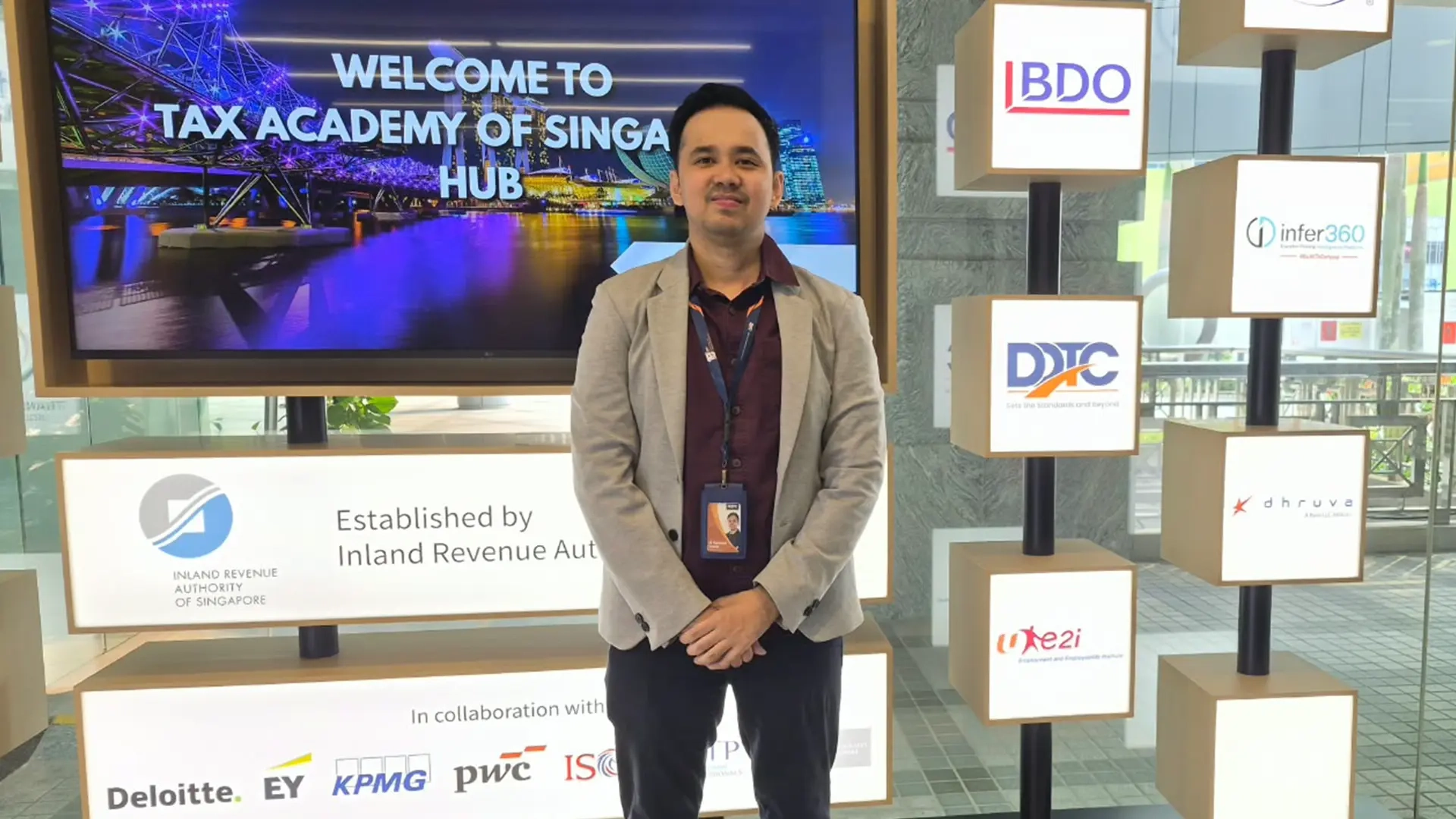
In addition to Putrawal, DDTC Consulting Senior Manager, Khisi Armaya Dhora, and DDTC Consulting Manager Wulan Clara Kartini also participated in the IIVT programme. The participation of these professionals in the training forms part of the Human Resource Development Programme (HRDP) that DDTC consistently carries out.
Through this programme, DDTC provides its professionals with the opportunity to participate in various competency development programmes, both domestically and abroad. All costs associated with participation in the programme are borne by DDTC with no service bond attached.
DDTC Founder Darussalam stated that DDTC consistently provides its professionals with opportunities to enhance their competencies through various education and training programmes, both in Indonesia and overseas.
In his view, the participation of DDTC professionals in these various programmes is expected to broaden their horizons whilst strengthening their competencies in keeping pace with developments in knowledge and tax practice at a global level. (dik)