



Examining Tax Treaty Scope in the Digital Tax Era

RUST, DDTCNews – Mornings in Rust, Austria, always begin quietly. Tourists stroll leisurely among old buildings whilst small boats crowd Lake Neusiedl. Even so, this tranquillity does nothing to dampen the discourse taking place in the conference rooms.
After participants at Rust Conference 2026 discussed the topic of tax rules in non-tax agreements, the discussion this time turned to a more fundamental question: to what extent do current tax treaties remain relevant in the face of new forms of taxation?
The session entitled Scope of Tax Treaties based on the OECD/UN Model Convention was moderated by Pasquale Pistone and Yariv Brauner. The discussion focused no longer on the level of rates or tax design, but on the boundaries of tax treaty scope.
Boundaries of Tax Treaty Scope
The United States (US) was one of the countries that affirmed its position. In its presentation, the US delegation considered the digital services tax (DST) to not fulfil the characteristics of income tax, as it is levied on gross turnover rather than net profit.
Accordingly, the US deems the DST as falling outside the scope of Article 2 of both the OECD and UN Model Conventions, and therefore not entitled to the benefits of a foreign tax credit or tax treaty protection.
This carries broader implications. From the US perspective, incorporating turnover taxes into tax treaties could potentially undermine the coherence of the tax treaty system.
The article on operating profit is built upon the concepts of net profit and permanent establishment, whereas the DST uses turnover and user location as the basis for taxation. This difference in foundation is deemed to complicate the application of rules for allocating the jurisdiction to tax.
A similar debate arose from Uruguay. Through the example of the Insurance Entities Turnover Tax (IIEA), that country's report demonstrated that not all taxes on revenues can automatically be categorised as income tax.
A ruling by Uruguay's tax authority even stated that the IIEA falls outside the scope of the tax treaty, as it is levied on gross revenue and is not listed as a covered tax under the agreement.
However, Uruguay also raised a more philosophical question. Is the definition of 'income tax' truly universal? If countries continue to develop new forms of taxation, might the boundary between income tax and turnover tax become increasingly blurred?
That question became one of the most compelling discussions in the session, as it touches upon the legal foundations of international tax treaties.
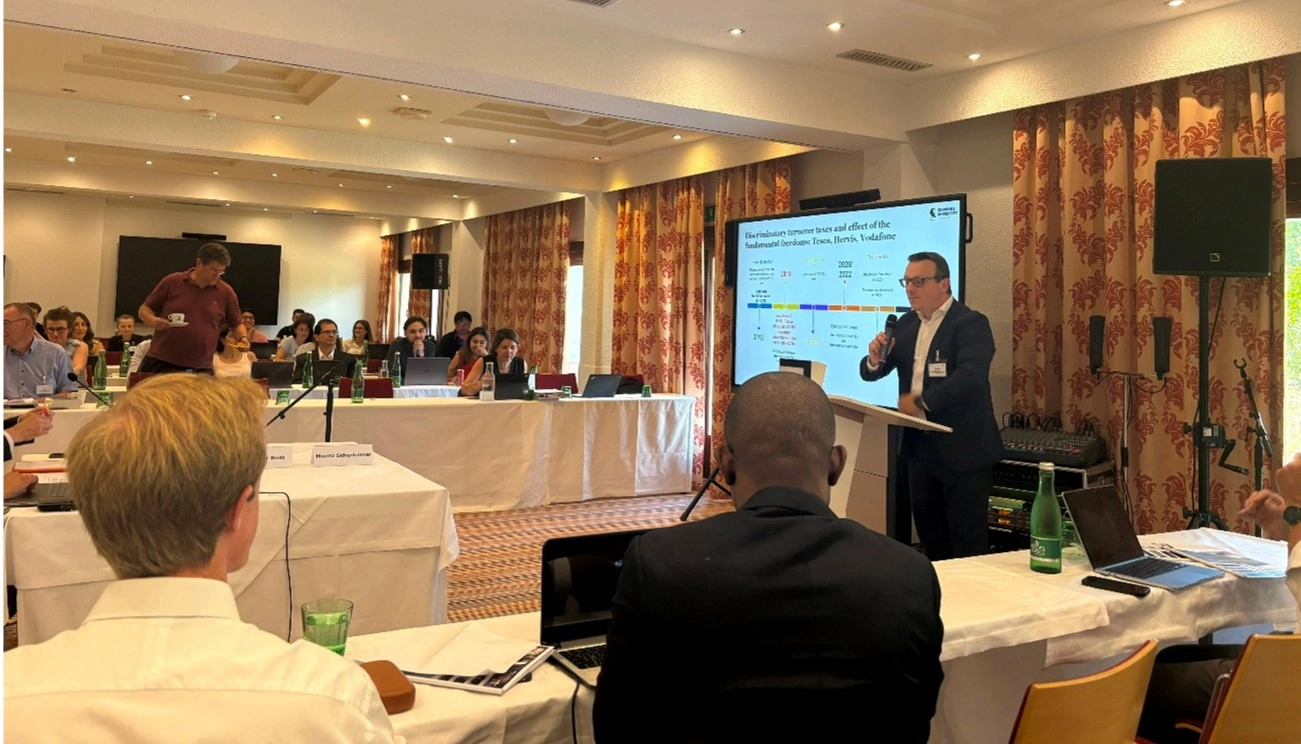 Photo caption: A presentation by one of the national reporters at Rust Conference 2026.
Representatives from Taiwan further enriched the discussion through their experience of taxing cross-border transactions in the digital sector, namely the 'Taiwan Cross-border E-Commerce Income Tax'.
In their report, Taiwan questioned whether the special regime applied to digital commerce is, in essence, a disguised form of DST, and how to prevent global digital companies from exploiting tax treaty provisions to gain undue advantages.
Outlook
If there is a common thread running through the various reports, the answer does not lie in the presence or absence of a DST. The real debate concerns the capacity of tax treaties to keep pace with evolving forms of taxation.
As more countries levy taxes based on turnover, user location or other economic indicators, the classical concept of income tax is beginning to face new challenges.
The discussion ultimately revealed that the future of tax treaties is determined not only by editorial changes to the OECD or UN Model Convention, but by whether consensus can be reached on what constitutes 'income tax' in the modern economy.
Without a shared understanding, disputes over the scope of tax treaties are bound to continue to rise in the development of the international tax system in the future. (rig)
*This article is reported by Senior Specialist of DDTC Consulting, Dawud A. Q Lubis, and Specialist of DDTC Fiscal Research & Advisory, Abiyoga S. Wiyanto.