



More Than a Souvenir: The Tradition Behind DDTC Library‘s MURI Record
THERE is a long-standing custom at DDTC whenever its professionals travel abroad, including during the Human Resource Development Programme (HRDP). That custom is bringing back books as souvenirs to Indonesia.
The practice originated from a message by DDTC Founder Darussalam to professionals travelling overseas. In addition to studying the latest tax topics, DDTC professionals have always been encouraged to purchase books as souvenirs that can enrich Indonesia's tax knowledge.
International tax literature is, of course, far from inexpensive. Nevertheless, this has been a commitment of tax experts and DDTC Founders, Darussalam and Danny Septriadi, since the firm was established. A reading habit is deemed an absolute prerequisite for a career in taxation.
"It is important to set aside time and funds for reading books," claimed Darussalam.
The books purchased have ultimately become part of the library's collection. It is therefore unsurprising that the library, now known as DDTC Library, has always been an integral part of the company's design and development.
One notable 'book-buying spree' that was reported on occurred when Danny Septriadi served as an expert witness in an arbitration trial relating to a tax dispute in London in 2018. On that occasion, Danny purchased dozens of books on law and taxation.
Another occasion arose when DDTC professionals travelled to India as delegates to an international tax conference organised by the Foundation for International Taxation (FIT), the International Bureau of Fiscal Documentation (IBFD) Amsterdam and the Organisation for Economic Co-operation and Development (OECD) Paris.
Those trips to India, in 2018 and 2019, also involved members of the DDTCNews editorial team as part of the DDTC delegation. Notably, the DDTC professionals departed with two deliberately empty suitcases and returned to Indonesia with those suitcases full of books.
The dozens of books brought back to Indonesia covered a wide range of topics, including transfer pricing, goods and services tax (GST), corporate governance and tax dispute resolution. There were also books on more specific subjects, such as taxation of the digital economy and general anti-avoidance rules (GAAR).
It is from this 'book-buying' habit that the DDTC Library collection has continued to grow. Naturally, in the current era of globalisation and economic digitalisation, additions to the collection can also be conducted online through various marketplaces and the websites of overseas book publishers.
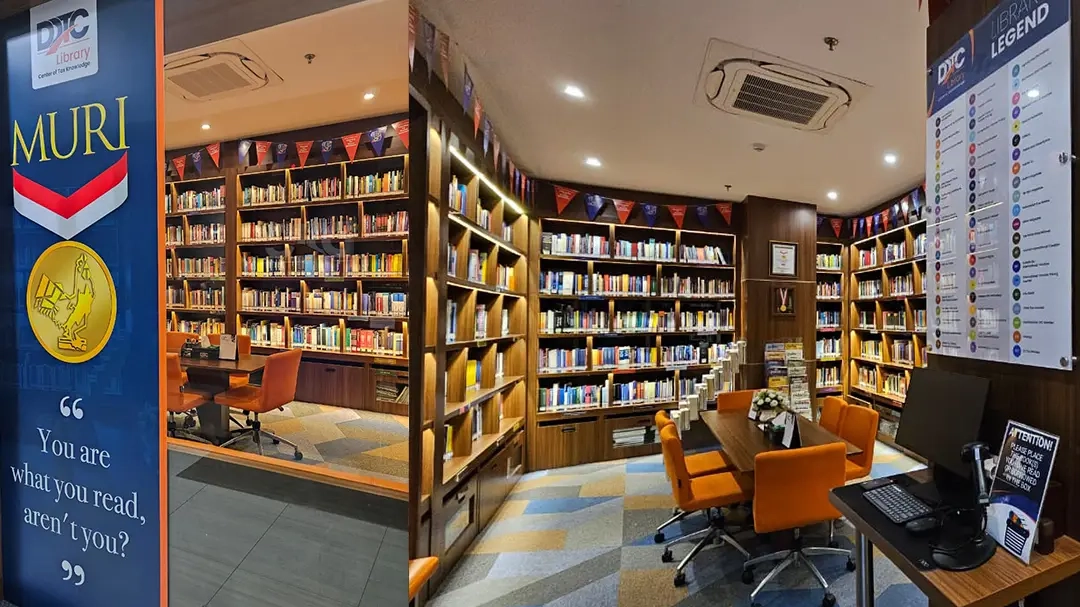
It is therefore unsurprising that in July 2026, the Museum Rekor – Dunia Indonesia (MURI) presented a certificate of achievement along with a medal to DDTC in recognition of the recording of DDTC Library's record as the Tax Library with the Largest Collection of Tax Literature.
The record was awarded after DDTC Library was confirmed to hold a total of 4,967 items of literature supporting the study of taxation as a multidisciplinary field. This collection comprises 3,259 core tax collection books and 1,708 complementary tax collection books.
The core tax collection covers literature addressing various aspects of domestic and international taxation. The complementary tax collection covers cross-disciplinary supporting literature, such as law, accounting, economics, and international trade as they relate to taxation.
The various items of literature are organised into more than 45 required topics, including transfer pricing, international taxation, tax audit & dispute, tax law, tax administration, tax system, taxation & technology, business reorganisation, tax research, taxes on income and wealth and other topics.
The majority of DDTC's collection comprises international literature from various renowned authors and publishers. These publishers include IBFD, Wolters Kluwer, Routledge, Hart Publishing, LexisNexis, the American Bar Association and so forth.
The various items of literature in DDTC Library ultimately form a comprehensive and integrated tax knowledge ecosystem. Further, the DDTC Library website is also connected to other digital platforms, including DDTCNews, Perpajakan DDTC and DDTC Academy.
Books and journals may serve as research sources. Research findings can develop into articles, publications and even legal arguments and advisory work. The same knowledge can then be subsequently developed through training and discussion.
Various domestic and international publications written by DDTC professionals also utilise the DDTC Library collection as one of their reference sources. The same applies to the 43 books published by DDTC.
This is what DDTC wishes to share with the public. Accordingly, DDTC Library is also open to the public. With this approach, DDTC Library does not merely serve as a storage facility for the collection, but becomes part of a sustainable tax knowledge ecosystem.
Tracing this back to its origins, the MURI record received by DDTC actually stems from something simple that has been carried out consistently, namely, the habit of DDTC professionals bringing books back as 'souvenirs' when travelling abroad, even packing empty suitcases from Indonesia for that very purpose.
In an era of readily accessible digital information, investing in books may appear conventional. Nevertheless, an abundance of information is not always equivalent to in-depth knowledge. To understand taxation in its entirety, literature that can explain concepts, history, arguments, policy comparisons and international practice remains essential.
For this reason, the MURI record held by DDTC Library is not merely a matter of the number of books arranged on shelves. The record marks a long journey of building a source of tax knowledge beneficial for education, research, professional practice and the formulation of tax policies.
For DDTC, that journey is still unfolding. This achievement is expected to encourage more universities, government bodies and other institutions to strengthen their tax collections and tax literacy in Indonesia. After all, behind every sound tax policy, there is always one fundamental and enduring requirement, namely adequate knowledge. (kaw)