

PER-9 and PER-19: Differences in Tax Invoice Access Deactivation

AN ENTREPRENEUR that has been registered as a taxable person (pengusaha kena pajak/PKP) will be granted access to prepare tax invoices. Referring to Article 64 paragraph (2) of MoF Reg. 81/2024, such access may be used from the date on which the obligations as a taxable person commence, as stated in the VAT registration decision letter.
However, access to prepare tax invoices may be deactivated for certain reasons. Deactivation of such access means the taxable person is unable to issue invoices. The detailed provisions on the deactivation of access to the preparation of tax invoices are set out in 2 regulations:
- PER-9/PJ/2025, which governs the deactivation of access to prepare tax invoices for taxable persons indicated as having issued or used invalid tax invoices; and
- PER-19/PJ/2025, which governs the deactivation of access to prepare tax invoices for taxable persons that have failed to fulfil their obligations pursuant to statutory provisions in the field of taxation.
Although both regulations govern the deactivation of access to prepare tax invoices, the grounds for deactivation under the two regulations differ. In addition, there are several other differences that also warrant attention. The following is a comparison of the provisions on deactivating tax invoice creation access under PER-9/PJ/2025 and PER-19/PJ/2025.
Grounds for Deactivating Access to the Preparation of Tax Invoices
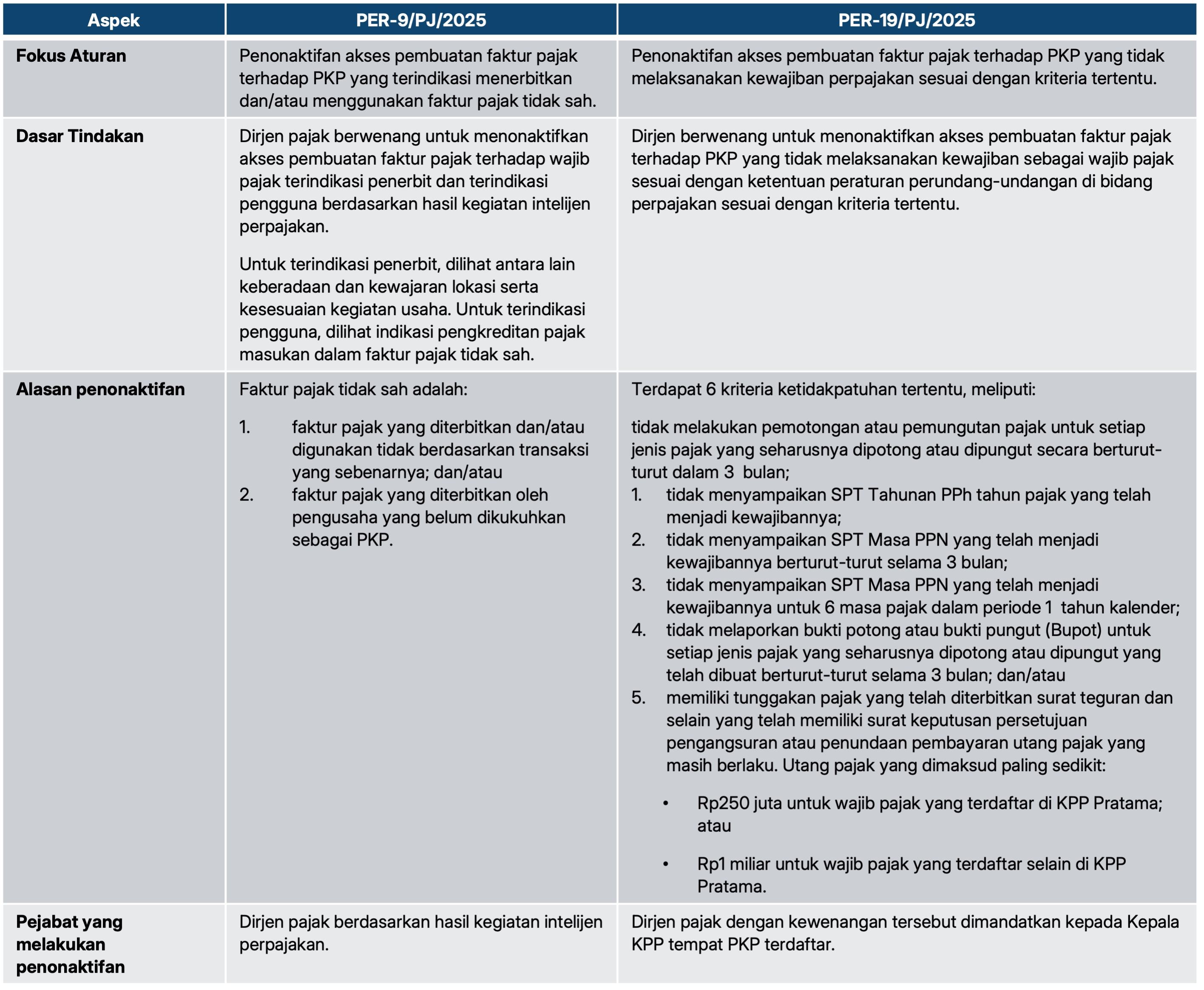
The grounds underlying the deactivation of access to prepare tax invoices differ between PER-9/PJ/2025 and PER-19/PJ/2025. In brief, PER-9/PJ/2025 focuses on indications of the issuance or use of invalid tax invoices, whereas PER-19/PJ/2025 focuses on non-compliance with tax obligations. See Grounds for Deactivating Access to the Preparation of Tax Invoices
Further, the deactivation of access to prepare tax invoices under PER-9/PJ/2025 is based on the results of tax intelligence activities. Meanwhile, the deactivation of access to prepare tax invoices under PER-19/PJ/2025 is triggered by a taxable person's non-compliance based on specified criteria. For ease of reference, the following sets out the differences in detail:
Clarification Procedures and Supporting Documents
A taxable person whose access to the preparation of tax invoices has been deactivated, whether because they are indicated as having issued or used invalid tax invoices or due to non-compliance, will be issued a notification. In addition, such a taxable person is afforded the right to submit a clarification.
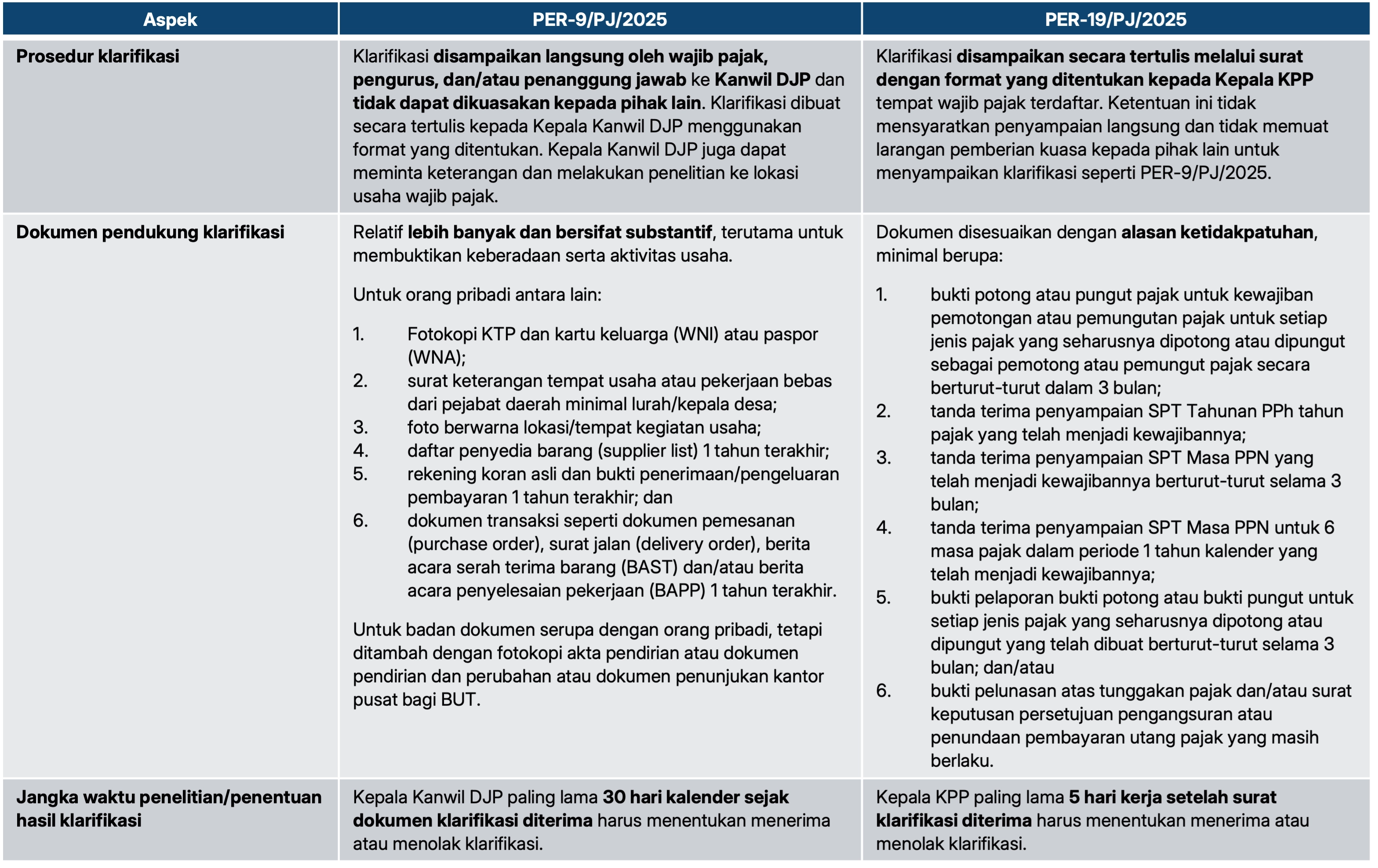
Although both are afforded the right to submit a clarification, there are several differences in the clarification procedures and supporting documents required under PER-9/PJ/2025 and PER-19/PJ/2025. In brief, the clarification mechanism under PER-19/PJ/2025 is simpler than that under PER-9/PJ/2025.
In addition, the supporting documents required under PER-9/PJ/2025 are fairly comprehensive, as they must demonstrate the existence and business activities of the taxable person, including transaction documents for the preceding 12 months.
On the other hand, PER-19/PJ/2025 requires only documents sufficient to demonstrate that the obligation forming the basis of the deactivation has been fulfilled. For ease of reference, the following sets out the differences in detail:
Follow-up to Clarification and Consequences
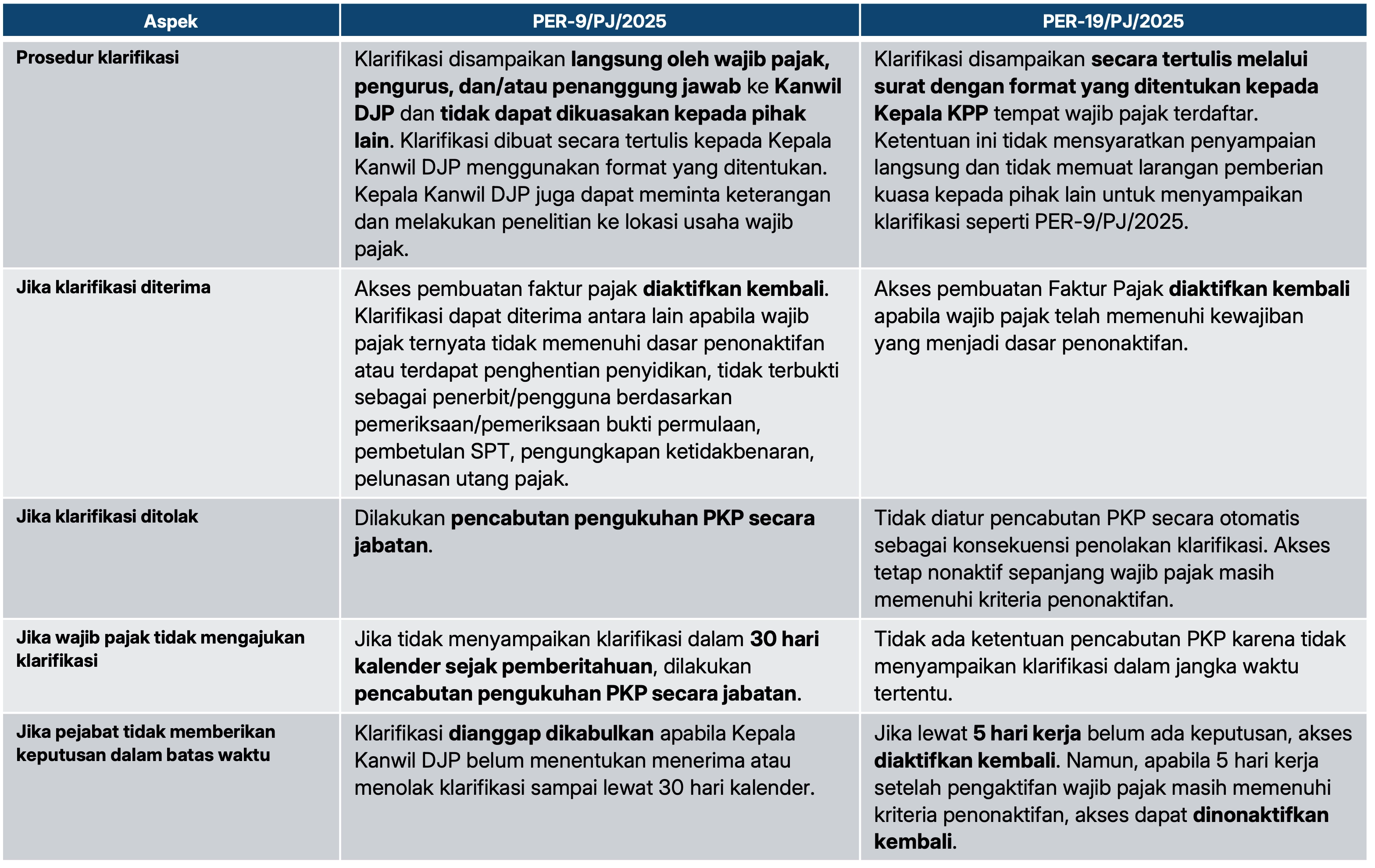
The follow-up to the clarification outcome and the consequences set out in PER-9/PJ/2025 and PER-19/PJ/2025 are considerably different. PER-9/PJ/2025 carries more stringent consequences, as it may result in the ex officio VAT deregistration.
Further, PER-9/PJ/2025 provides that if the head of the Regional Office does not issue a decision within 30 days, the taxpayer's clarification shall be deemed to have been granted. In such circumstances, the head of the Directorate General of Taxes (DGT) Regional Office shall reactivate the taxpayer's access to the preparation of tax invoices.
Meanwhile, PER-19/PJ/2025 provides that a delay in issuing a decision will result in the access to the preparation of tax invoices being reactivated. However, access to the preparation of tax invoices may be deactivated again if, within 5 business days following reactivation, the taxpayer still fulfils the relevant criteria. For ease of reference, the following sets out the differences in detail:
(rig)