



Saving the Earth Through Tax Law
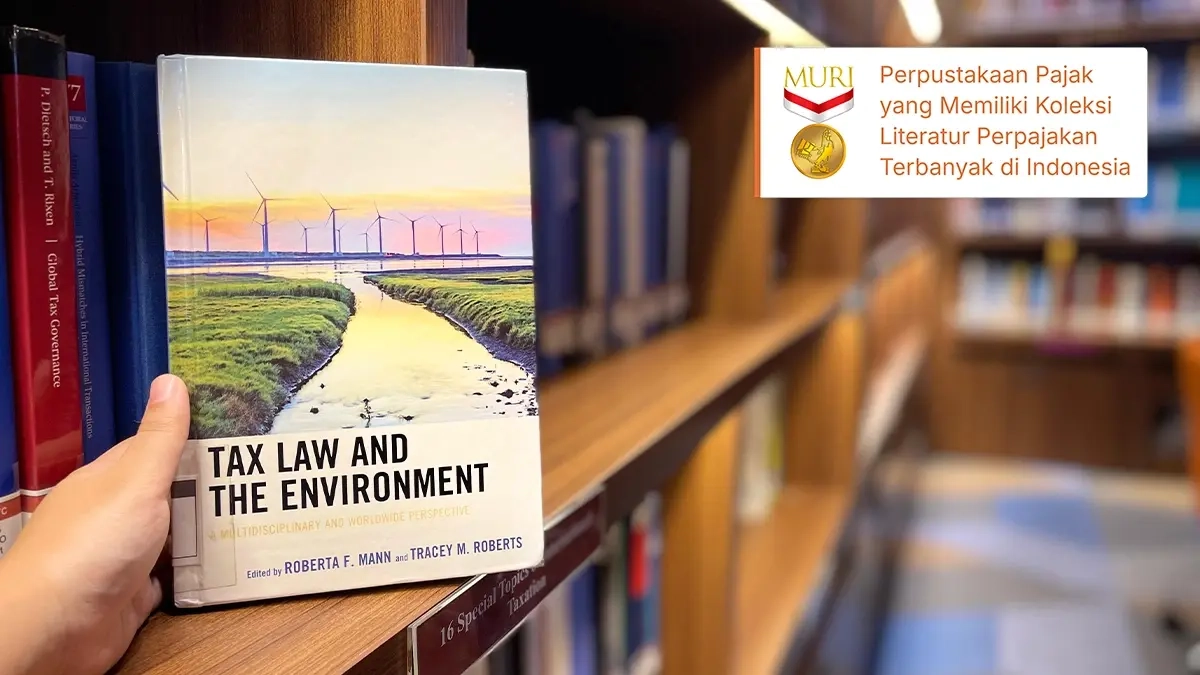
FOR many years, tax law and environmental science seemed to inhabit two entirely separate worlds. Traditional tax systems were viewed as revenue-collection machines. Meanwhile, environmental policy was regarded merely as an instrument of restriction or prohibition.
However, as the global climate crisis grows ever more pressing and natural disasters have become an almost daily occurrence, nations across the globe have come to recognise one thing: taxation can serve as a powerful compass for changing human and industrial behaviour.
Through the book Tax Law and the Environment: A Multidisciplinary and Worldwide Perspective, edited by Roberta F. Mann and Tracey M. Roberts, readers are invited to understand the role of taxation as an instrument for protecting environmental sustainability.
Published in 2018, this book combines legal, public economics and scientific perspectives from leading experts around the world. It also advances a clear thesis: a tax system is never neutral with respect to the environment.
Yet without sound policy design, a tax system can itself become the 'fuel' that accelerates environmental degradation. Conversely, if designed scientifically and equitably, environmental taxes can become the primary driver of the transition towards a low-carbon economy.
The book is divided into 3 complementary parts, covering tax incentives for fossil fuels, case studies of environmental tax implementation across various countries and specific issues relating to taxation and the environment.
In the introductory section, Janet E. Milne invites readers to survey the landscape of environmental taxation comprehensively. She argues that the intellectual foundations of environmental taxation are rooted in Arthur C. Pigou's thinking on Pigouvian tax in his work The Economics of Welfare (1920).
In brief, Pigou's thinking forms one of the foundations for the polluter pays principle, whereby the party responsible for pollution or environmental damage must bear the social costs generated by its economic activity.
However, applying Pigouvian theory in practice is far from straightforward, particularly when it comes to determining the magnitude of environmental harm that the polluter must bear.
In practice, governments may employ 2 principal approaches. First, imposing additional charges on activities that damage the natural environment, such as carbon taxes, fuel taxes or waste user charges.
Second, providing incentives, tax deductions or tax credits for individuals or companies that adopt clean technologies, such as incentives for electric vehicles or solar power generation.
At the close of her introduction, Milne cautions that environmental taxes may potentially erode a country's tax revenues over the long term.
Readers are then led to understand a policy paradox in the United States through the first part of the book. On the one hand, the US promotes emissions reductions. On the other, its history of tax policy reveals the existence of wide-ranging incentives for oil, gas and coal manufacturers.
Chapter 1, written by George K. Yin, uncovers the history of the emergence of tax incentives for oil and gas manufacturers in the US. These incentives were originally designed during the First World War and have persisted, in part owing to the strength of political lobbying.
In Chapter 2, Michael J. Graetz examines the politics of energy pricing. In his analysis, politicians tend to be reluctant to raise fuel taxes for fear of the electoral consequences. As a result, fuel prices in the US remain relatively low compared with the environmental costs they generate.
In Chapter 3, the tax treatment of coal also comes under scrutiny. Despite coal being the largest contributor to emissions, US tax law provides various capital gains treatments and cost allowances that keep the coal industry artificially competitive.
In the second part of the book, readers are taken on a tour of environmental tax practices across different parts of the world, each with its own distinctive characteristics.
In Chapter 4, Takeshi Kawakatsu, Sven Rudolph and Soocheol Lee analyse the provisions of the Japanese Global Warming Tax levied on fossil fuels as well as the challenges of aligning carbon policy across the East Asia region.
In Chapter 5, Natalie P. Stoianoff examines the political dynamics of carbon taxation in Australia. The carbon taxation scheme was enacted under Prime Minister Julia Gillard but was subsequently repealed following a change of government and pressure from the mining industry.
Meanwhile, in Canada, Deborah L. Jarvie, in Chapter 6, illustrates how the Province of British Columbia pioneered the revenue-neutral carbon tax. Every dollar of carbon tax revenue is returned to the community in the form of reductions in personal and corporate income tax.
In Chapters 7 and 8, respective contributors discuss the Nordic countries' experience of implementing carbon taxes to reduce emissions without impeding economic growth as well as the development of environmental tax instruments in Central American and Latin American countries, which face challenges of administrative capacity and energy poverty.
Interested in reading about the experiences of those countries and learning about specific issues relevant to environmental taxation? Please visit DDTC Library.
To date, DDTC Library holds 5,078 items in its literature collection, supporting the study of taxation as a multidisciplinary field. DDTC Library has also received a MURI Record as the Tax Library with the Largest Collection in Indonesia on 10 July 2026.
Before visiting DDTC Library, members of the public are advised to confirm their visit in advance via the hotline +62-21-2938-2700 or by email at [email protected]. Please also follow DDTC Library on Instagram for the latest information on tax literature. (rig)