



Boosting Capital Markets: 2 Tax Incentives to Consider
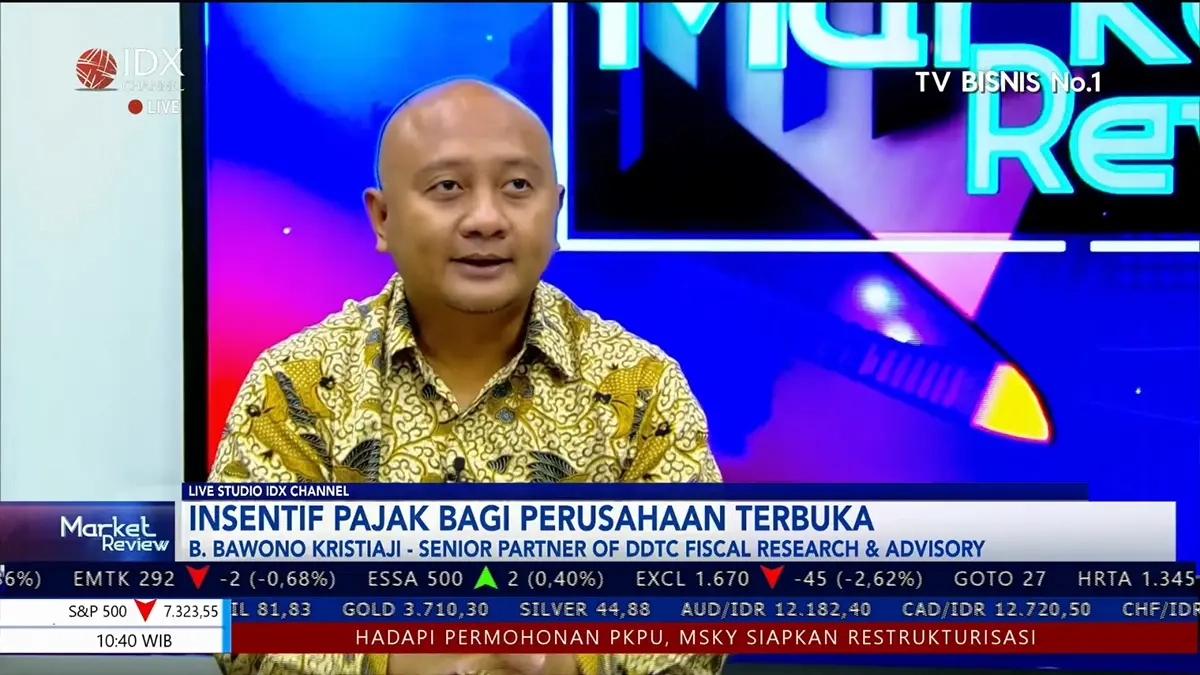
JAKARTA, DDTCNews - Tax incentives are regarded as one of the fiscal instruments that can stimulate funding in the capital market and encourage companies to undertake an initial public offering (IPO).
Bawono Kristiaji, Senior Partner of DDTC Fiscal Research & Advisory, said the government has provided an incentive in the form of a 3-percentage-point reduction in the corporate income tax rate for public companies that fulfil the requisite conditions. Unfortunately, the number of companies availing themselves of this incentive remains relatively low.
"As per our observation, only around 20–25% of issuers listed on the exchange are utilising this corporate income tax rate reduction. Why? Because one of the most commonly cited concerns is the 40% free float requirement, which turns out to be quite substantial for companies," he said during the Market Review on IDX Channel, Thursday (19/11/2026).
Referring to Article 65 of Government Regulation (Gov. Reg.) 55/2022, as amended by Gov. Reg. 20/2026, Bawono explained that corporate taxpayers must satisfy 3 conditions to obtain the corporate income tax rate of 19%, which is lower than the standard rate of 22%.
First, the company must be in the form of a public company. Second, at least 40% of the total paid-up shares must be traded on a stock exchange in Indonesia. Third, certain specified conditions must be met. Those specified conditions include:
- Shares with a 40% free float must be held by a minimum of 300 parties;
- Each such party may only hold less than 5% of the total issued and fully paid-up shares;
- The 40% free float condition must be satisfied for a minimum of 183 calendar days within a period of 1 tax year; and
- Compliance with these conditions must be carried out by the public company taxpayer by submitting a report to the Directorate General of Taxes (DGT).
Bawono noted that public companies consider the 40% public shareholding requirement to be rather burdensome. As a result, relatively few companies are able to meet the conditions to benefit from the corporate income tax rate reduction incentive.
"From the companies' perspective, there is a wait-and-see attitude or reluctance to genuinely release 40% of their shares to the public. If we look at comparative studies, the 40% free float is actually among the highest in the world," he said.
Bawono noted that several countries, such as Turkey, Bangladesh and Tanzania, have offered similar tax incentives with free float requirements. However, the free float threshold in those countries is only 25%, lower than that of Indonesia.
In light of the foregoing, Bawono believes the government could consider a graduated reduction in the corporate income tax rate based on the proportion of publicly held shares (free float). Under this scheme, the amount of the incentive would not be determined solely by a single rate of reduction.
He gave the example that issuers with a free float of 15%–25% could receive a corporate income tax rate reduction of a certain amount. Meanwhile, issuers with a free float of 25%–30% could receive a larger rate reduction.
"Previously, the requirement was based on a single rate. So why not make it graduated? For instance, if the free float or public shareholding is 15–25%, a certain reduced rate is applied. Then, for a shareholding of 25%–30%, a different reduced rate applies and so on. This actually prevents companies from seeing the target as too distant, so they can progress towards it gradually," he said.
Supertax Deduction
In addition to the graduated corporate income tax rate reduction, Bawono proposed a supertax deduction facility. In his view, prospective issuers require a facility allowing a gross income deduction for costs incurred in preparing for an initial public offering (IPO).
"Supertax deductions have actually already been applied to vocational and research and development (R&D) activities. Why not extend them to pre-IPO activities? This warrants further study, because frankly it is attractive to companies. It turns out that the decision to list on the exchange is influenced by the upfront costs that must be borne," he said.
The government could also evaluate the imposition of a 0.1% final income tax on share sale transactions on the stock exchange, as regulated under Article 244 of the Minister of Finance Regulation (MoF Reg.) 81/2024, as amended by MoF Reg. 1/2026. Such an evaluation could be used to understand issuer behaviour and assess the effectiveness of the various tax incentives provided.
Overall, Bawono is of the view that tax incentives can increase companies' interest in listing on the exchange. Furthermore, improvements to the regulatory framework can also foster deeper capital markets going forward.
He expressed hope that all stakeholders, including the Indonesia Stock Exchange (IDX), the Financial Services Authority (Otoritas Jasa Keuangan/OJK in Indonesian) and the Ministry of Finance (MoF), could collaborate to determine the most appropriate tax incentive scenario.
Such measures are necessary to encourage financing, enhance liquidity, deepen the capital market and support the achievement of the targets set out in the National Medium-Term Development Plan (Rencana Pembangunan Jangka Menengah Nasional/RPJMN in Indonesian).
"With that spirit, I am optimistic that this is feasible. We need a holistic roadmap covering what the obstacles are, what the solutions are and what the government can offer to businesses listed on the exchange," he claimed. (rig)