



DGT Issues New Guidelines on Taxpayer Compliance Oversight
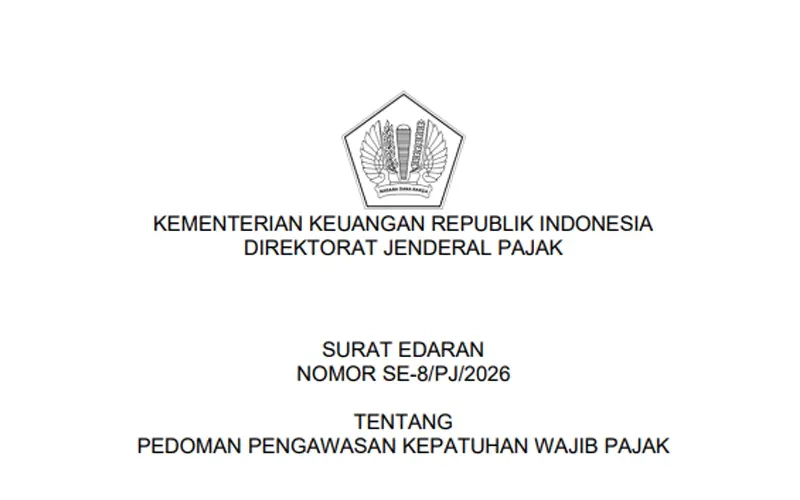
JAKARTA, DDTCNews – Director General of Taxes, Bimo Wijayanto, has officially issued new guidelines on taxpayer compliance supervision. The guidelines are contained in the Director General of Taxes Circular Letter (Surat Edaran/SE in Indonesian) Number SE-8/PJ/2026 concerning Guidelines for the Supervision of Taxpayers' Compliance.
This circular letter repeals and replaces four previous circular letters simultaneously, namely SE-14/PJ/2019 concerning Procedures for Extensification, SE-11/PJ/2020 concerning Procedures for Field Data Collection Activities and Data Quality Assurance in the Context of Database Expansion, SE-05/PJ/2022 concerning the Supervision of Taxpayers' Compliance and SE-9/PJ/2023 concerning the Settlement of the Follow-Up on Concrete Data.
SE-8/PJ/2026 has been issued in line with the entry into force of MoF Reg. 111/2025 concerning the Supervision of Taxpayers' Compliance, the implementation of the coretax administration system, the results of evaluations of supervision as well as input from stakeholders
"These improvements are directed at sharpening the supervision business process, adjusting to developments in information technology and aligning with other DGT's business processes, such as education, audits, intelligence and law enforcement," reads an excerpt from the General section of SE-8/PJ/2026, cited on Friday (17/7/2026).
Still within the General section, this improvement of the business process is also aimed at enhancing the accountability of formal examination, clarifying the differentiation of compliance examination techniques and integrating examination support and follow-up on the results of supervision activities.
SE-08/2026 is intended as guidelines for DGT employees in implementing taxpayer compliance supervision for both registered and unregistered taxpayers comprehensively. This ensures uniformity and continuity. In addition, this circular letter also serves as guidelines for regional supervision through data collection activities to develop a quality database.
The objectives of its issuance include:
- providing guidelines for the implementation of MoF Reg. 111/2025;
- providing guidelines for implementing business processes that support taxpayer compliance supervision activities;
- improving the efficiency and effectiveness of supervision in the context of achieving sustainable taxpayer compliance, both for registered and unregistered taxpayers, as well as supporting the achievement of optimal tax revenue; and
- strengthening the tax database that fulfils data quality dimensions as a basis for revenue potential exploration and other tax purposes.
The scope of SE-8/PJ/2026 covers 8 matters, namely:
- definitions;
- general provisions;
- supervision planning;
- establishment of a compliance committee;
- preparation of supervision plans;
- taxpayer assignment and working areas;
- supervision of registered taxpayers;
- general provisions on the supervision of registered taxpayers;
- planning for the supervision of registered taxpayers;
- implementation of the supervision of registered taxpayers;
- supervision of taxpayer groups;
- settlement of follow-up on concrete data;
- visits to registered taxpayers;
- follow-up on the supervision of registered taxpayers;
- quality assurance for the supervision of registered taxpayers;
- supervision of unregistered taxpayers;
- general provisions on the supervision of unregistered taxpayers;
- planning for the supervision of unregistered taxpayers;
- implementation of the supervision of unregistered taxpayers;
- follow-up on on results of the supervision of unregistered taxpayers;
- quality assurance for the supervision of unregistered taxpayers;
- regional supervision through data collection activities (kegiatan pengumpulan data/KPD in Indonesian);
- general provisions on regional supervision through data collection activities;
- planning for data collection activities;
- preparation for the implementation of data collection activities;
- implementation of data collection activities;
- follow-up on results of data collection activities;
- quality assurance for data collection activities;
- automated supervision through the DGT information system;
- monitoring and evaluation of taxpayer supervision;
- monitoring of taxpayer supervision;
- evaluation of taxpayer supervision;
- provisions on the involvement of other work units within the Ministry of Finance (MoF) (where required);
- other provisions.
General Provisions on the Supervision of Taxpayers' Compliance
Pursuant to the general provisions, the DGT may conduct 3 types of supervision, namely:
- supervision of registered taxpayers, namely through a request for explanation of data and/or information (penjelasan atas data dan/atau keterangan/P2DK in Indonesian), issuance of advisories, and issuance of reprimands;
- supervision of unregistered taxpayers, namely through requests for explanation of data and/or information in the context of extensification; and
- regional oversight — through regional-based data collection activities, analysis of data collection activities, other data collection activities for duties and functions and data collection activities for non-duties or functions.
Data and/or information obtained in the course of supervision of registered taxpayers or unregistered taxpayers shall be followed up by means of data collection activities.
Such supervision covers supervision that may encompass one, several or all taxes, for one or several taxable periods, fraction of a tax year or a tax year as well as supervision of taxpayer economic activities and the identification of taxpayers in each working area.
The types of tax subject to supervision include income tax, value added tax (VAT), sales tax on luxury goods (STLGs), stamp duty, land and building tax (L&B Tax), sales tax, carbon tax and other taxes administered by the DGT.
All supervision (registered, unregistered and regional) is implemented through the DGT supervision administration system. Where this system is not yet available, oversight is implemented through the DGT administration system.
"The assignment of an account representative (AR) and/or DGT employee … shall be conducted through the issuance of a Supervision Order," reads an excerpt from the General Provisions section, letter j.
The head of the Regional DGT Office is responsible for optimising the role of the supervision sub-committee within the Regional Office compliance committee. Meanwhile, the head of the Tax Office (Kantor Pelayanan Pajak/KPP in Indonesian) is responsible for optimising the KPP compliance committee and for prioritising human resources within the Section of Tax Supervision that has duties and functions related to the supervision of strategic taxpayers.
In implementing the supervision business process, DGT employees must equip themselves with interpersonal skills, analytical skills and an understanding of statutory tax provisions.
DGT employees are directed to independently and regularly upgrade and update their understanding of the supervision business process and these skills by utilising the available knowledge management resources.
The DGT Head Office, Regional DGT Offices and Tax Offices may periodically organise employee education and/or training within their respective work units, with a view to upgrading and updating understanding of the supervision business process, interpersonal skills, analytical skills and understanding of statutory tax provisions.
"In implementing supervision, DGT employees shall be required to uphold the DGT code of ethics and code of conduct as well as the values of the Ministry of Finance," reads an excerpt from the General Provisions section, letter p.
One of the key aspects of SE-8/PJ/2026 is the 3 types of material compliance examination, namely comprehensive examination, simple examination and automated examination.
Material compliance examination refers to examination activities of a taxpayer's compliance in fulfilling material tax obligations or provisions stipulated under statutory provisions in the field of taxation.
Comprehensive examination refers to a material compliance examination covering all taxes that constitute a taxpayer's obligations in a comprehensive manner, including through business process analysis, financial statement analysis and/or transfer pricing analysis, for tax years prior to the current tax year.
Simple examination refers to a material compliance examination covering some or all taxes with a specific taxpayer scope, including through business process analysis and/or financial statement analysis, for the current tax year and/or tax years prior to the current year.
Automated examination refers to a material compliance examination covering one or several taxes and one or several taxable periods on a limited basis.
"With the enactment of this circular letter, ... the implementation of supervision of registered taxpayers, supervision of unregistered taxpayers and regional supervision shall refer to this circular letter," reads an excerpt from the Closing section of SE-8/PJ/2026, which was enacted on 15 July 2026. (kaw)