



TP: Business Restructuring Doesn‘t Always Trigger Exit Charge

SINGAPORE, DDTCNews - Business restructuring is one of the complex issues in transfer pricing analysis. Changes to a business structure can cause a shift in functions, assets and risks between entities, which, in turn, affects the allocation of profit potential within a business group.
That complexity increases when restructuring is carried out within a multinational group operating across multiple jurisdictions. In such circumstances, transfer pricing analysis must not only focus on how transactions are priced after the restructuring, but must also consider whether any functions, assets, risks, rights or profit-generating opportunities have transferred from one entity to another.
At its core, business restructuring from a transfer pricing perspective relates to a cross-border reorganisation of commercial and financial relations and/or a reallocation of functions, assets and risks within a multinational group.
Accordingly, not every change in business activity can automatically be categorised as a business restructuring. Such changes must be examined in the context of the relationships between entities within the group and their impact on the commercial and financial arrangements that were previously in place.
In other words, restructuring must be determined based on the substance of the changes that have occurred, not merely on the basis of changes to the organisational structure or the profitability of an entity.
Notably, business restructuring is fundamentally a business decision before it becomes a transfer pricing issue. Multinational groups may restructure for a variety of commercial reasons.
Such reasons include achieving economies of scale, improving efficiency, centralising certain functions, optimising procurement functions, relocating manufacturing activities, integrating acquisitions or moving strategic functions to a particular entity within the group.
Consequently, commercial rationale serves as an important starting point for understanding why a business restructuring was undertaken and what economic changes the group sought to achieve.
As an illustration, an entity that previously acted as a fully fledged distributor may have its function converted to that of a limited-risk distributor. Prior to the restructuring, that entity could have performed distribution functions more broadly, used the relevant assets and assumed various business risks, thereby having the opportunity to earn a higher profit level.
After the restructuring, certain functions and risks may be transferred to another entity performing centralised functions. Such changes may ultimately result in the restructured entity receiving more limited remuneration compared with its position prior to the restructuring.
However, a change in the level of remuneration or a decline in profitability following a restructuring does not in itself demonstrate that something of value has been transferred. Analysis therefore cannot stop at a comparison of profits before and after the business restructuring.
According to Carlo L. Navarro, Head of Tax at Deloitte Philippines and Transfer Pricing Leader at Deloitte Southeast Asia, the analysis must look further into what has actually changed, which functions and risks have genuinely transferred and who substantively performs and controls those activities after the restructuring.
In that context, accurate delineation is one of the important aspects of analysing business restructuring. Accurate delineation is necessary to ensure that the changes in functions and risks claimed in the restructuring have indeed occurred in substance.
For example, if a group states that the procurement function has been moved from Entity A to an entity performing centralised procurement, but decisions regarding supplier selection terms and conditions, volumes, delivery timescales or purchase prices are still made by Entity A, the procurement function may not have genuinely transferred.
Accordingly, analysis of a business restructuring must examine which party makes decisions, performs day-to-day activities, controls risks and has the financial capacity to assume those risks. This implies that contractual or administrative changes do not necessarily reflect economic changes.
Once changes in functions, assets and risks (FAR) have been accurately identified, the analysis must then consider whether the restructuring has caused profit potential to shift from one entity to another.
However, a transfer of profit potential does not automatically mean that the entity that has lost that profit potential is entitled to receive compensation. The focus of the analysis should be directed at a more fundamental question: what has actually transferred and whether that something has economic value.
Such something of value may take the form of an intangible, customer list, contractual rights, know-how, inventory, business opportunity or going concern.
Where something of value exists, the analysis must then consider whether, under the arm's length principle (ALP), independent parties in comparable circumstances would provide compensation for such a transfer or relinquishment.
Customer List and Something of Value
Further, Uziel Alvarez, an international tax practitioner and Global Head of Tax at a fintech company, gave the example of an entity transferring a customer list. In his view, the value of a customer list depends greatly on the type of industry or the characteristics of the company concerned.
For example, a customer list belonging to a company selling luxury goods may have a different value from a customer list belonging to a company selling mass market goods.
Mass market goods are fundamentally aimed at a broad and diverse consumer base. By contrast, luxury goods target a more specific and identifiable customer segment. Accordingly, the two customer lists may have different characteristics and economic values.
This is also consistent with Carlo's explanation that the existence of something of value does not imply that every transfer of something automatically gives rise to compensation.
The question that must be answered is whether the transferred object genuinely has economic value. Where the transferred object is a customer list for mass market goods, for instance, that list may provide a benefit in terms of time savings because the recipient does not need to establish a customer base from scratch. However, that benefit does not automatically mean that compensation must be provided.
Conversely, for luxury goods, a customer list containing the identities of high-value customers with relevant ties to the business may have greater economic value. In certain circumstances, independent parties may be willing to pay to obtain such a customer list.
Consequently, there are 2 matters to consider in the transfer of a customer list. First, whether the customer list has economic value for the party receiving it.
Second, whether independent parties in comparable circumstances would be willing to pay to obtain that benefit.
Business restructuring should not be viewed solely as a matter of profit shifting or the determination of an exit charge. Analysis must begin with the reasons why the restructuring was undertaken, the changes that have occurred in substance, what has actually transferred and whether something of value has been transferred in the process.
Transfer pricing analysis can then distinguish between a change in the business model that merely alters the functions and risk profile, a transfer of specific assets or rights, a transfer of an intangible or business opportunity, and the valuation of a going concern.
Accordingly, the existence of something of value in a business restructuring does not automatically give rise to a compensation obligation. The determination of an exit charge must be performed only after the substance and value of what has been transferred have been accurately identified, including by considering whether independent parties in comparable circumstances would be willing to provide compensation for that transfer.
This approach ensures that transfer pricing analysis of business restructuring is grounded in economic substance and the ALP, rather than merely in changes in profitability before and after the restructuring.
Report from Singapore
For information, this report was written by Novi Hartanti, Assistant Manager at DDTC Consulting, who is attending the WU-TA Advanced Transfer Pricing Programme 2026 in Singapore. The programme takes place from 28 September to 1 October 2026.
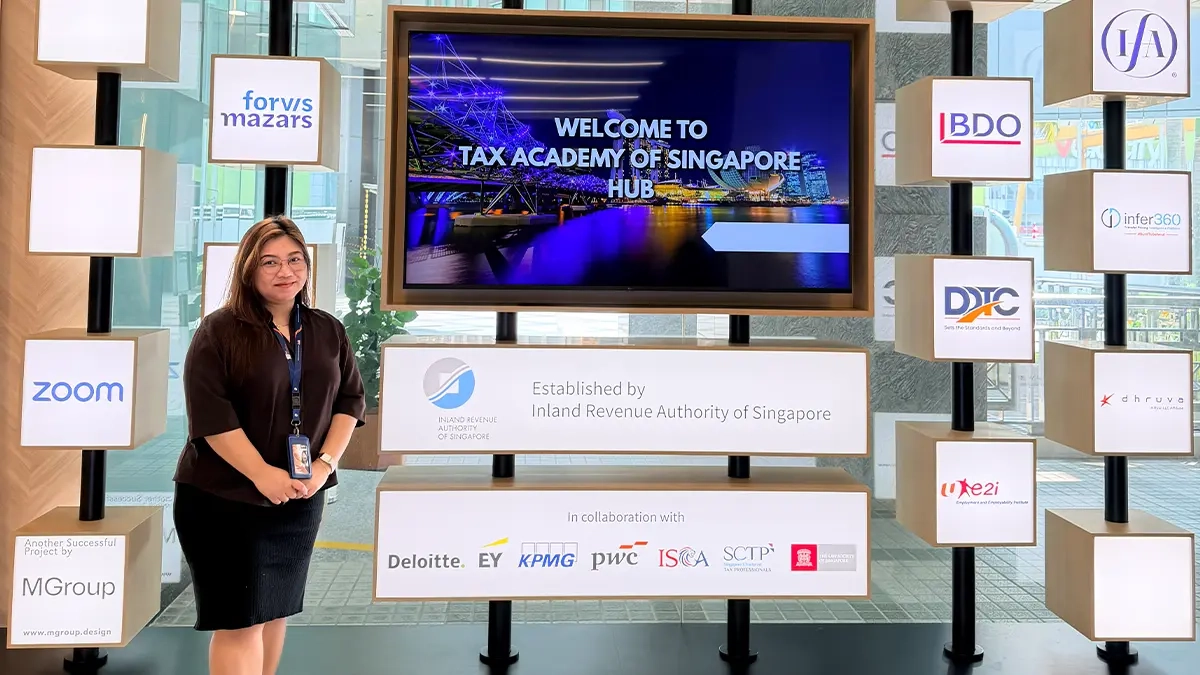
In addition to Novi, 5 other DDTC professionals are participating in the programme. Their participation in this training forms part of the Human Resource Development Programme (HRDP) run by DDTC.
Through this programme, DDTC provides its professionals with the opportunity to develop their competencies through various training programmes, both domestically and abroad. All costs associated with participation in the programme are borne by DDTC with no contractual obligation attached.
DDTC Founder Darussalam, who is also one of Indonesia's leading tax experts, stated that the participation of DDTC professionals in the programme is aimed at strengthening their understanding of developments and practices in transfer pricing at the international level.
In his view, the knowledge and perspectives gained from this international training can support DDTC professionals in handling various transfer pricing issues and in providing services and advisory to clients to a standard that exceeds expectations.
Participation in the international training programme also forms part of DDTC's commitment to continuing to invest in its human resources. This investment is made through various competency development programmes, including professional training and the award of scholarships for study at leading universities across the globe.
This commitment is in line with DDTC's vision of becoming a tax institution grounded in research, technology and knowledge that sets the standards and beyond. (rig)