



Intragroup Loans: Transaction Delineation Key to Transfer Pricing
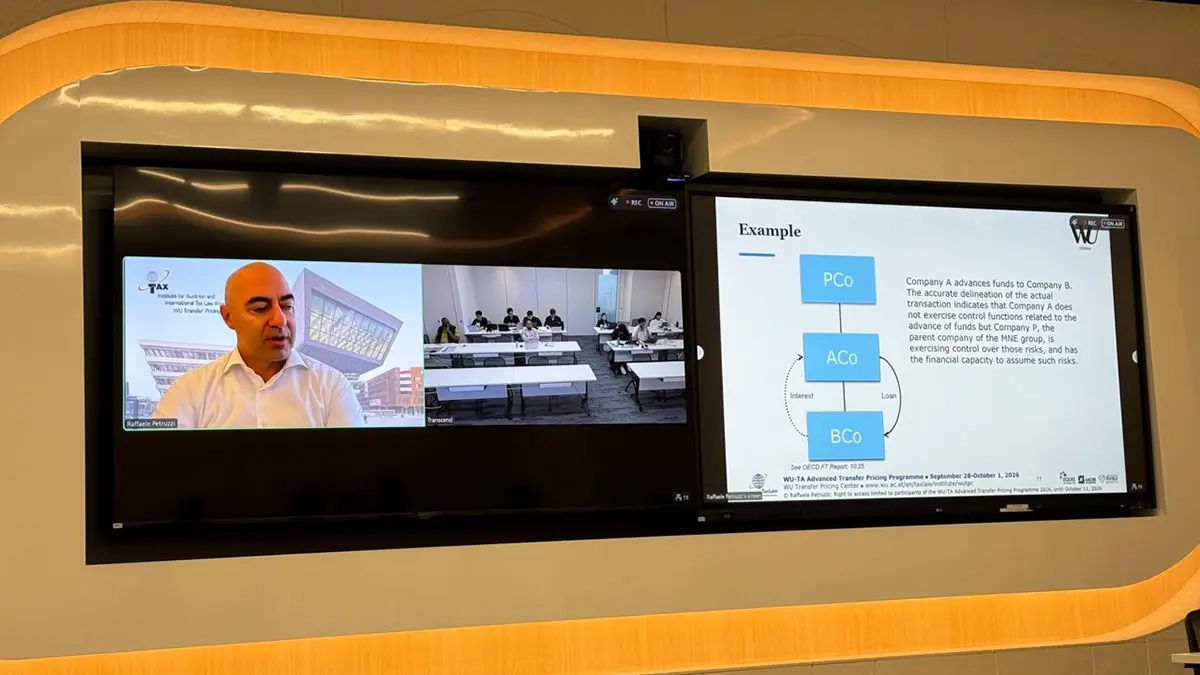
SINGAPORE, DDTCNews - Transfer pricing analysis of intragroup financial transactions does not stop at determining the interest rate. Before establishing the price or return on a transaction, taxpayers must first understand the substance of the transaction, its financial characteristics and which party actually performs the functions and assumes risks.
This was stated by Raffaele Petruzzi, Managing Director of the WU Transfer Pricing Center at the Institute for Austrian and International Tax Law at WU (Vienna University of Economics and Business), during a session of the WU-TA Advanced Transfer Pricing Programme 2026 in Singapore.
According to Petruzzi, one of the fundamental steps in analysing intragroup financial transactions is to delineate the transaction. This step is necessary to ensure that transfer pricing analysis is not based solely on what is written in the contract, but also takes into account the economic reality of the transaction.
“So, the first thing you need to do is delineate the transaction; by applying the 5 economically relevant characteristics,” he said.
In the context of intragroup loans, Petruzzi explained that the transaction characteristics to be considered include, among others, the loan amount, maturity, repayment schedule, the nature and purpose of the loan, guarantees, seniority or subordination, the geographical location of the borrower, currency, collateral and the type of interest applied.
In his view, all of these characteristics are crucial for determining how a financial transaction should be understood and subsequently analysed in accordance with the arm's length principle (ALP).
“All of these characteristics are important because they allow you to delineate a loan accurately,” he said.
The Contract Is Only the Starting Point of the Analysis
One issue that may arise in intragroup loan transactions is where the agreement does not include economically significant information, such as the loan's maturity date.
Petruzzi gave an illustration of a loan agreement that did not include a maturity date. In his view, the absence of such information does not mean the analysis should stop at the contract. On the contrary, one must look at how the transaction was actually conducted.
“The contract is merely the starting point of your analysis,” he said.
As an example, if a loan is granted to finance a project projected to begin generating positive cash flows and to be repaid within a certain period, that period may provide an indication of the actual economic maturity of the loan.
Conversely, if it was known from the outset of the loan that it would not be repaid within the period specified in the contract, one must question whether the contractual term truly reflects the economic conditions of the transaction.
In certain circumstances, an even more fundamental question may arise as to the character of the transaction. If there are indications from the outset that the funds will never be repaid, consideration must be given to whether the transaction is truly a loan or whether it has characteristics more closely resembling equity.
“There are situations where, from the moment the loan is made, you already know the funds will never be repaid. If that is the case, you need to start questioning whether this transaction is really a loan or actually something else, such as equity,” he explained.
According to Petruzzi, this illustration demonstrates that transfer pricing analysis must not stop at the contractual form of a transaction.
“In transfer pricing, do not simply stop at what is written in the contract,” he said.
Commercial Rationality as an Important Step
Once a transaction has been delineated on the basis of its economic characteristics, the subsequent analysis must consider whether the transaction possesses commercial rationality.
According to Petruzzi, the question to be asked is whether the loan represents a transaction that independent parties would rationally undertake.
“You need to question whether the loan has commercial rationality, whether it is rational and whether 2 independent parties would enter into that loan transaction,” he explained.
If the transaction is assessed as commercially rational, it may be treated as a loan and its interest rate then analysed according to the ALP.
However, if the transaction does not demonstrate commercial rationality, the analysis may proceed to the question of whether the transaction should be recognised in accordance with its formal structure.
This discussion illustrates that transfer pricing analysis of intragroup financial transactions involves several interrelated steps. The determination of the price or interest rate is just one part of the overall analysis that must first be properly understood.
Accordingly, economic substance is an essential element in ensuring that intragroup financial transactions are analysed consistently with their actual conditions.
As Petruzzi emphasised, analysis cannot rely solely on contractual documents; it must also examine how the transaction actually took place and which party, in practice, performs the functions and assumes the associated risks.
Report from Singapore
On another note, this report was written by DDTC Consulting Specialist Daffa Ardhi Satryo, who is attending the WU-TA Advanced Transfer Pricing Programme 2026 in Singapore. The programme is being held from 28 September to 1 October 2026.
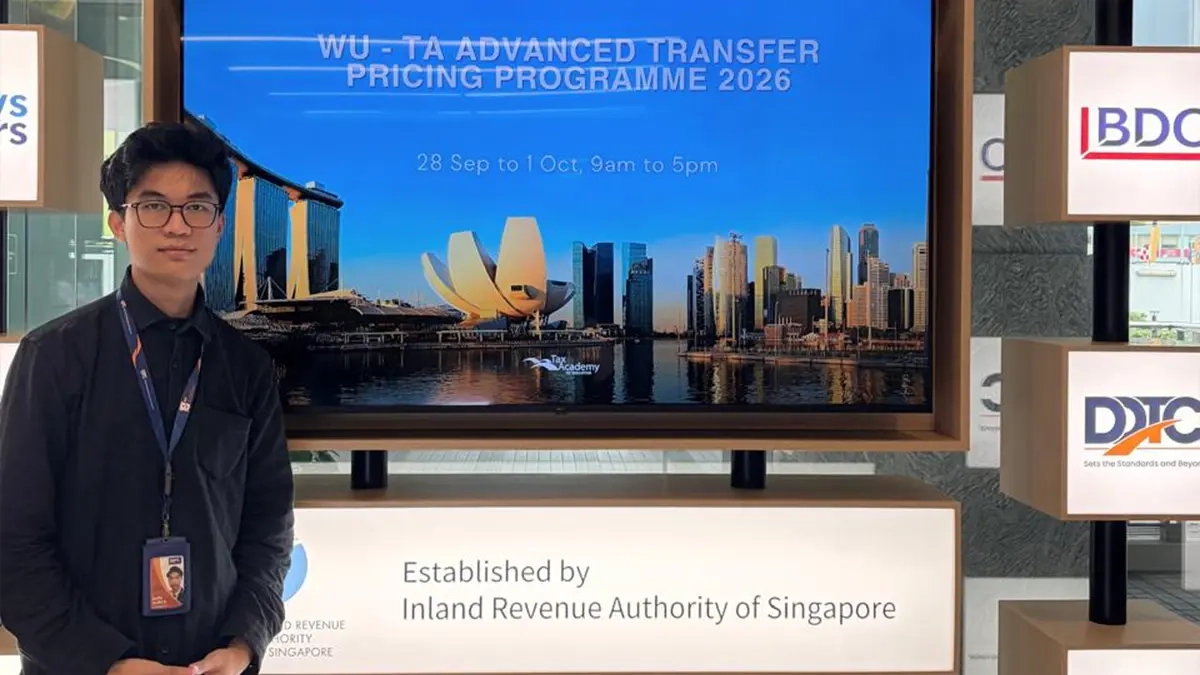
In addition to Bagus, 5 other DDTC professionals are attending the programme. Their participation in the training is part of the Human Resource Development Programme (HRDP) run by DDTC.
Through this programme, DDTC provides its professionals with the opportunity to develop their competencies through various training programmes, both domestically and abroad. All costs of participation in the programme are borne by DDTC with no service bond attached.
DDTC Founder Darussalam, who is also one of Indonesia's leading tax experts, stated that the participation of DDTC professionals in the programme is aimed at strengthening understanding of developments and practices in international transfer pricing.
In his view, the knowledge and perspectives gained from such international training can support DDTC professionals in handling various transfer pricing issues and in providing services and advisory to clients to a standard that exceeds expectations.
Participation in this international training programme also forms part of DDTC's commitment to continually invest in its human resources. Investment in human resources is carried out through various competency development programmes, including professional training and the provision of scholarships for study at leading universities worldwide.
This commitment is in line with DDTC's vision of becoming a research-, technology-, and knowledge-based tax institution that sets the standards and beyond. (rig)