



MoF Reviews Tax Incentive Schemes Amid Persistent Gaps
JAKARTA, DDTCNews - The government is working to improve the structure of tax incentives to boost investment without placing excessive pressure on revenue.
Yon Arsal, Assistant to the Minister of Finance for Tax Compliance Affairs, said the incentives currently in force in Indonesia still have 3 gaps: a design gap, a growth-revenue trade-off gap and a global coordination gap. The design gap arises because tax incentives currently in force in Indonesia remain focused on physical investment, even as business models shift towards digitalisation.
"There is a discussion as to whether the existing incentives are still compatible with future business models," Yon remarked at the International Tax Conference 2026, Wednesday (16/9/2026).
The growth-revenue trade-off gap arises because tax expenditure resulting from incentives continues to grow whilst the benefits of those incentives have not been properly evaluated.
Finallythe global coordination gap arises because, to date, several incentives are ineffective in light of the application of the global minimum tax under the global anti-base erosion (GloBE) rules.
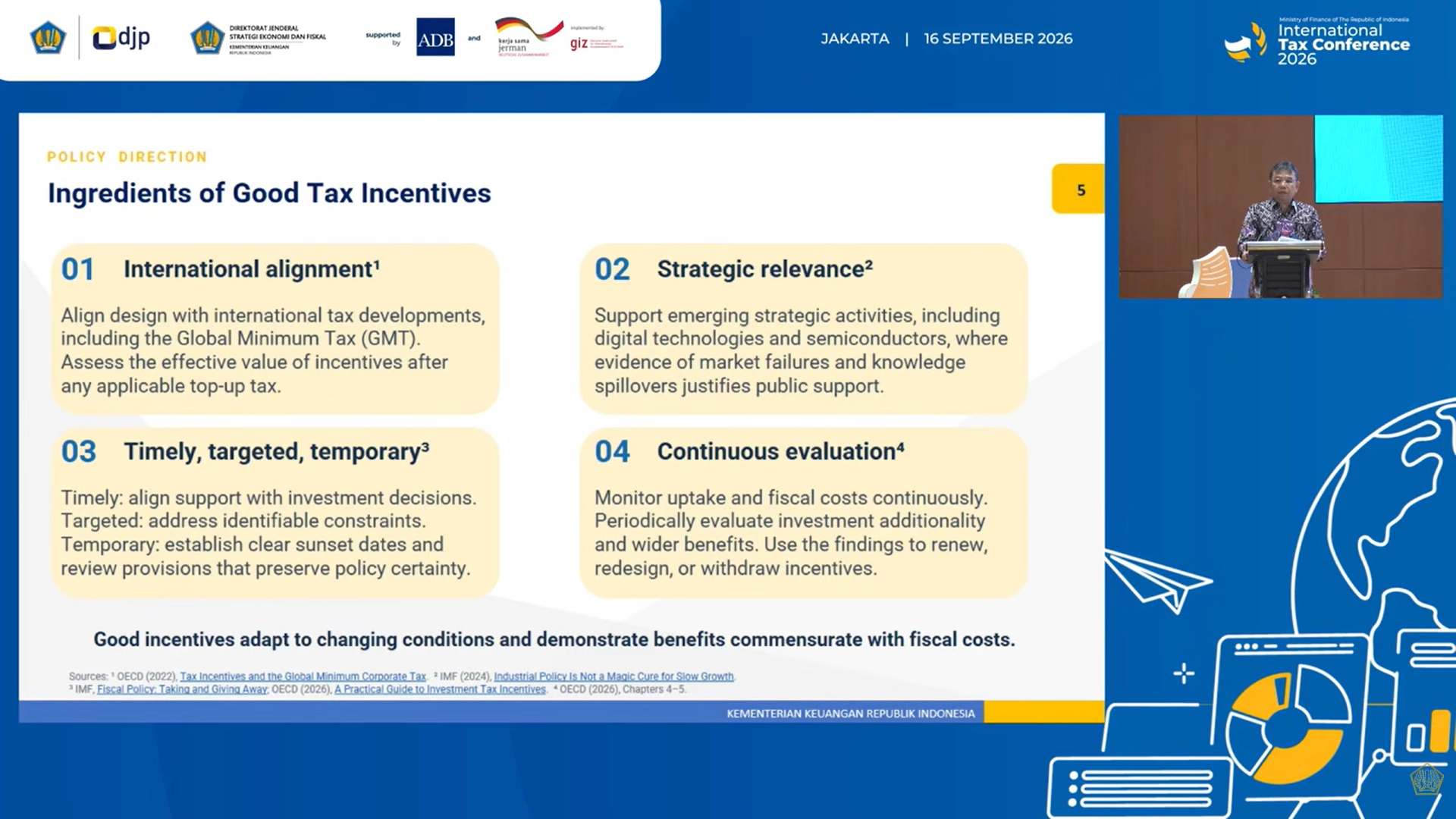
Yon said there are 4 requirements that must be fulfilled to establish sound tax incentives. First, the tax incentive must be aligned with the latest international tax structure, in particular the global minimum tax.
With the application of the global minimum tax, Indonesia needs to limit the use of the tax holiday and begin considering alternative incentive schemes.
"There are several incentive schemes compatible with the global minimum tax, such as cash grants or tax credits," said Yon.
Second, tax incentives must have strategic relevance, implying that they must be aligned with the latest economic developments. Yon said the incentives currently in force in Indonesia remain broad-based and can therefore be utilised by many sectors.
This stands in contrast to neighbouring countries, which focus the granting of tax incentives solely on the digital sector.
"Malaysia, Thailand and Vietnam grant tax holidays to the digital industry and renewable energy. In the Indonesian context, we need to think about industrial change in the future," said Yon.
Third, tax incentives must be timely, targeted and temporary. Fourth, tax incentives must be continually evaluated to ensure their benefit to the economy.
Through such evaluation, the government has a basis on which to continue, redesign or revoke incentives currently in force.
"The Ministry of Finance, through the Directorate General of Taxes (DGT), the Directorate General of Economic and Fiscal Strategy (Direktorat Jenderal Strategi Ekonomi dan Fiskal/DJSEF in Indonesian) and the Inspectorate General, has coordinated to evaluate the incentives that have been implemented," claimed Yon. (dik)