



New Regulation Prompt DDTC Academy Global Minimum Tax Seminar
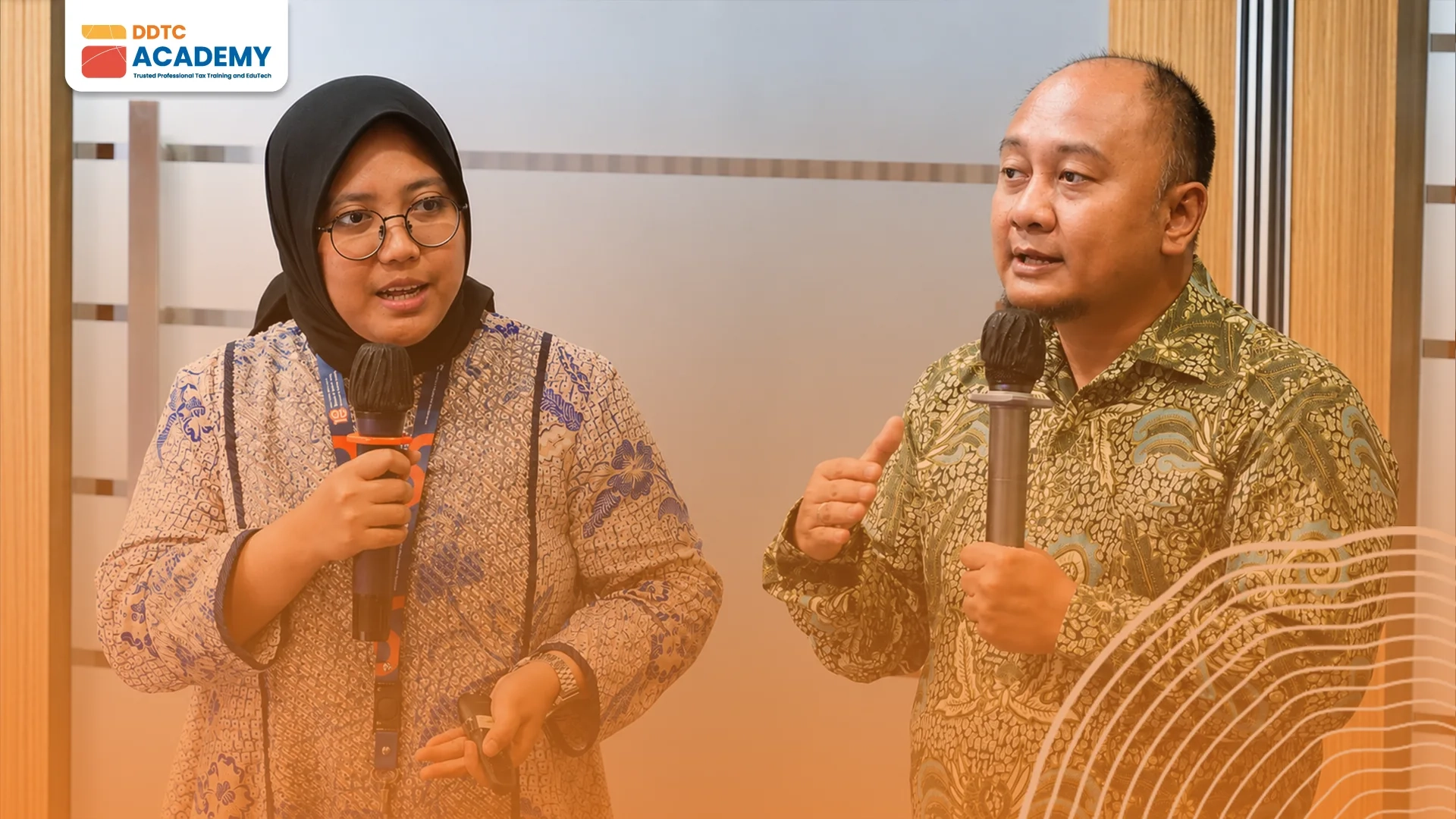
DDTC Academy held an exclusive tax update seminar entitled Wake-up Call! Update on the Application of Global Anti-Base Erosion Rules Following the Issuance of PER-6/PJ/2026 today, Wednesday (24/6/2026). Held in a hybrid format at Menara DDTC and via Zoom, the event was attended by 43 participants.
Participants from various companies received presentations from two DDTC professionals who are members of the DDTC Global Minimum Tax Expert Panel. The presenters also hold the Advanced Diploma in International Taxation (ADIT) from the Chartered Institute of Taxation (CIOT) of the United Kingdom.
The two presenters in question are Senior Partner, DDTC Fiscal Research & Advisory B. Bawono Kristiaji, S.E., M.S.E., M.Sc.IBT., ADIT., BKP. and Assistant Manager, DDTC Fiscal Research & Advisory, Hamida Amri Safarina, S.H., ADIT., BKP.
Comprising DDTC professionals who have followed the dynamics of the OECD/G-20 Two Pillar Solution from the outset, this expert panel is dedicated to providing capacity building on global minimum tax.
The professionals within the DDTC Global Minimum Tax Expert Panel have extensive experience in providing assistance, conducting research and preparing advisory work relating to the implementation of global anti-base erosion rules (GloBE) for a number of multinational enterprises.
They also conduct readiness assessments and impact analyses; QDMTT documentation and working papers; GIR filing compliance and global minimum tax returns; and other strategic advisory work relating to the implementation of global minimum tax.
The enthusiasm of participants was evident from the numerous questions raised to the presenters. The discussion on global anti-base erosion rules that took place during this hybrid seminar was both interactive and dynamic.

The presenters divided the discussion into 3 main subtopics. First, the dynamics and developments of the global minimum tax. Second, the stages of the global minimum tax analysis pursuant to MoF Reg. 136/2024. Third, the administrative aspects of the global minimum tax pursuant to PER-6/PJ/2026.
As an opening, participants were invited by the presenters to revisit the latest developments in the global anti-base erosion rules (GloBE) at the international level. In addition, the presenters shared an understanding of the regulations governing global minimum tax in Indonesia.
The discussion continued with the stages of global minimum tax analysis pursuant to MoF Reg. 136/2024, covering the determination of which multinational enterprise groups are in scope to the determination of the effective tax rate and top-up tax.
In addition, the presenters also outlined opportunities to adopt safe harbour rules. As is known, the safe harbour rules are intended to reduce the compliance burden of the global minimum tax for multinational enterprise groups and the administrative burden on the tax authority.
The presenters then reviewed the administrative aspects of GloBE rules pursuant to PER-6/PJ/2026. This topic is crucial as the issuance of that regulation marks a new chapter in the implementation of GloBE in Indonesia.
As an implementing regulation of MoF Reg. 136/2024, PER-6/PJ/2026 should serve as a 'wake-up call' for GloBE taxpayers. Moreover, this regulation elucidated procedures for the exercise and fulfilment of obligations under the global minimum tax regime.
In their presentations, the presenters explained that PER-6/PJ/2026 governs various administrative and operational aspects of GloBE, ranging from the determination of GloBE taxpayer status, the filing of the GloBE Annual Income Tax Return, DMTT and/or UTPR, the filing of GIR, through to the submission of notifications.
This regulation also contains provisions on the payment and remittance of top-up tax, post-filing adjustments, supervision, audits as well as mechanisms for amendments and dispute resolution.
As international tax rules grow ever more complex, a thorough understanding of the technical and implementation aspects of GloBE is becoming increasingly crucial for business practitioners, academics and the tax authorities.
On anoher note, DDTC has also released a booklet entitled Tax: Implication for Indonesian Taxpayers. In addition, to build understanding among taxpayers, DDTC also actively presents various forms of articles, including news items, via the DDTCNews platform.
DDTC also provides a dedicated webpage related to global minimum tax. Moreover, DDTC has also conducted several capacity building sessions, in the form of seminars for the public, strategic dialogues with multinational enterprises, webinars with universities, live IG sessions with tax centres and in-house training (IHT) and IHT-Advisory.
Through this event, DDTC Academy once again reaffirms its commitment to supporting the professional development of tax practitioners. This is expected to support tax professionals in navigating the challenges of global anti-base erosion rules.
If you were unable to attend this event, you may participate in other regular programmes to be held by DDTC Academy. There are plans for further programmes on the topic of global minimum tax. You can view the various 2026 DDTC Academy programmes via the booklet entitled Rooted, Growing & Trusted.
In addition, DDTC Academy offers training that can be tailored to a company's needs regarding the implementation of the global minimum tax. This training can be combined with advisory services to form an IHT-Advisory.
Do you have inquiries concerning DDTC Academy programmes? Please contact the DDTC Academy WhatsApp Hotline at 0812-8393-5151 (Minda), email [email protected] or via the DDTC Academy Instagram account (@ddtcacademy).