



DGCE Revises Regulation on Inspections of Excisable Goods Operators
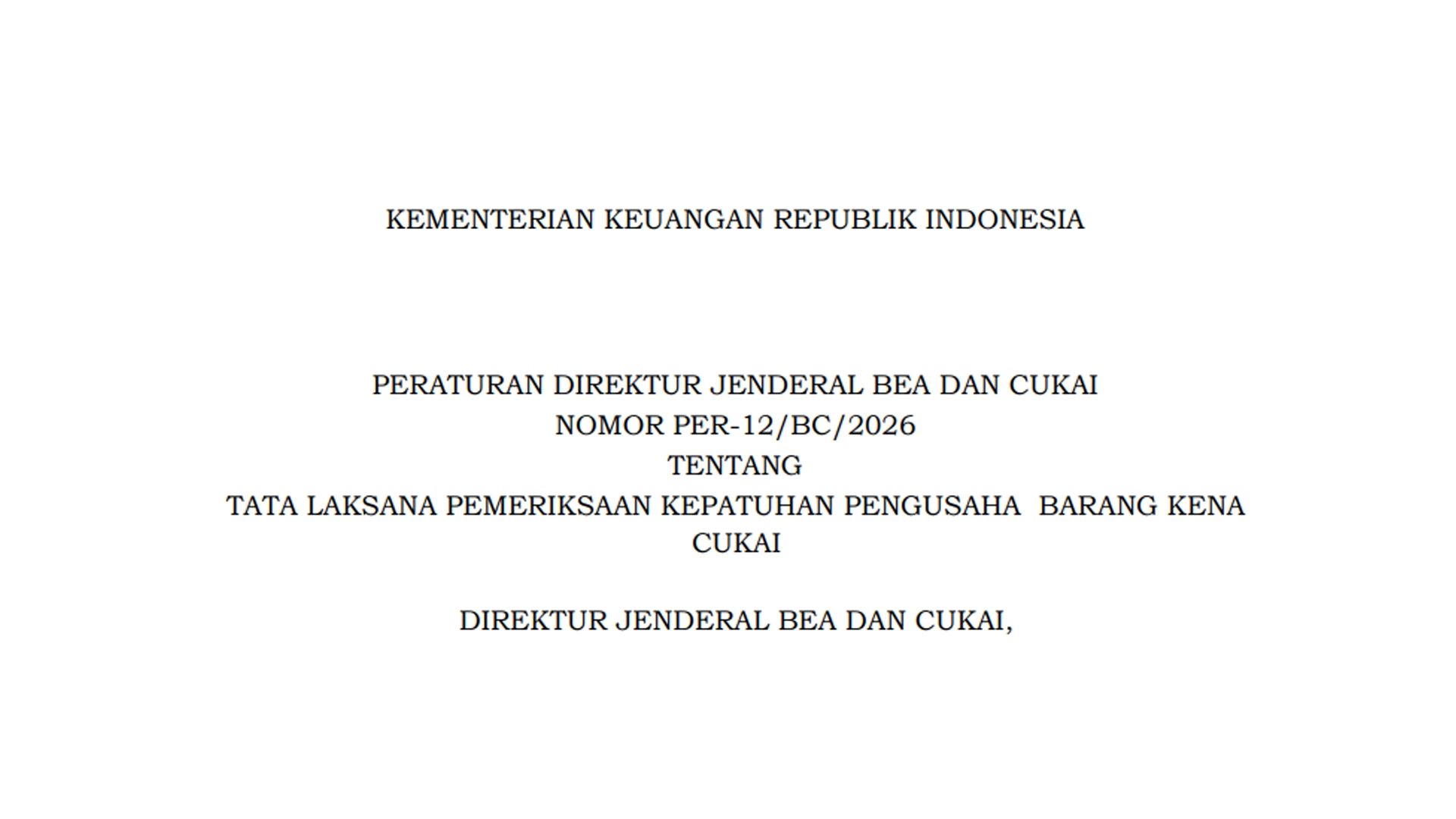
JAKARTA, DDTCNews – The Directorate General of Customs and Excise (DGCE) has updated the procedures for compliance inspections of excisable goods (BKC) operators. The update was carried out through the Director General of Customs and Excise Regulation No. PER-12/BC/2026.
The regulation, which takes effect from 1 January 2027, repeals and replaces PER-10/BC/2023. The replacement was undertaken to improve compliance among excisable goods operators whilst standardising the governance of excise document analysis and compliance inspections.
"Director General of Customs and Excise Regulation Number PER-10/BC/2023 concerning Procedures for inspections of the Compliance of Excisable Goods Operators needs to be replaced," reads the considering section of PER-12/BC/2026, cited on Tuesday (13/10/2026).
Through PER-12/BC/2026, the DGCE has, among others, overhauled the compliance inspection mechanisms; elaborated on the determination of inspection objects; and introduced specific provisions on excise document analysis for tobacco products manufacturers.
Article 2 paragraph (1) of PER-12/BC/2026 affirms that compliance inspections are implemented to ensure excisable goods operators have fulfilled their obligations pursuant to the applicable provisions. The compliance inspections target:
- excisable goods operators with an identity in the form of an excisable goods operator identification number (nomor pokok pengusaha barang kena cukai/NPPBKC in Indonesian); and
- users of excise exemption facilities with an identity in the form of an exemption user identification number (nomor pokok pengguna pembebasan/NPP in Indonesian).
Pursuant to Article 3 paragraph (1) of PER-12/BC/2026, the DGCE classifies compliance inspections into 2 types: routine and ad hoc. PER-12/BC/2026 also elaborates on the indicators considered when determining inspection objects, both for routine and ad hoc inspections.
Routine inspections are conducted periodically with planning carried out within 1 calendar year. The determination of objects of routine compliance inspections is conducted by considering 4 matters:
- excisable goods operators that have never been subject to compliance inspections;
- the workload and number of employees at the regional offices (kantor wilayah/kanwil in Indonesian), public service offices (kantor pelayanan umum/KPU in Indonesian) or customs and excise offices (kantor pengawasan dan pelayanan bea dan cukai/KPPBC in Indonesian);
- the risk profile of the excisable goods operators; and/or
- information indicating non-compliance by the excisable goods operators.
PER-12/BC/2026 also elaborates on the indicators used to determine objects of ad hoc inspections. This type of inspection may be conducted based on indications of non-compliance, analytical results indicating non-compliance, functional supervisory results and/or recommendations from other work units within the DGCE.
Specifically for tobacco product operators, compliance inspections are conducted based on the results of excise document analysis. Such analysis is carried out using data derived from excise documents in the form of:
- documents for orders of tobacco excise stamps (CK-1);
- documents for the notification of finished excisable goods for tobacco products (CK-4);
- documents for the notification of mutations of excisable goods (CK-5) with excise facilities;
- official reports of inspections (BACK-1) in the context of obtaining proof of receipt for the return of excise stamps (CK-3); and/or
- excise documents and/or other excise complementary documents.
Excise document analysis may be conducted on either a routine or ad hoc basis. In principle, such analysis produces a ratio value categorised into 2 types: a reasonable ratio or an unreasonable opinion ratio.
Analytical results falling within the unreasonable opinion ratio category serve as the basis for follow-up to compliance inspections. For routine analysis, follow-up is carried out through a routine compliance inspection. For ad hoc analysis, the follow-up takes the form of an ad hoc compliance inspection.
PER-12/BC/2026 has also established ratio normality thresholds through Appendix I. This provision warrants attention, as its calculated results serve as the basis for categorising analytical findings as either reasonable or unreasonable opinion.
“Excise document analysis is a series of inspection, examination and assessment activities of the reasonableness of documents related to activities in the field of excise to ensure the correctness of data, compliance with the provisions under excise regulations as well as to identify potential risks of violation, implemented specifically for tobacco products manufacturers,” reads Article 1 number 1 of PER-12/BC/2026. (dik)