



Deleted WHT Receipts, Global Trends in Pre-populated Returns Explained

An estimated 1.9 million individual taxpayers are suspected of deliberately deleting withholding receipts from their draft 2025 Annual Income Tax Returns. The Directorate General of Taxes (DGT) sent an email blast to 475,698 of those taxpayers, urging them to amend their Annual Income Tax Returns. According to the Director General of Taxes, Bimo Wijayanto, the potential income tax on the deleted withholding receipts amounts to approximately IDR2.01 trillion.
This situation is closely linked to the new method of filing annual income tax returns through Coretax. Withholding receipts and the related income reported by the withholding party are now automatically pre-filled in the draft annual income tax return of individual taxpayers. This scheme is known as pre-populated.
Simply put, under the pre-populated scheme, the tax authority pre-fills the return with data obtained from third parties, such as employers, banks or other government agencies. Taxpayers need only review, confirm, or correct the contents before submitting the return.
It turns out Indonesia is not alone. The latest OECD report entitled Digitalisation and Digital Transformation in Tax Administrations: Regional Trends and Insights (2026) describes pre-populated returns as one of the most significant developments in the return filing process in recent years.
“One of the most significant developments in the tax return process in recent years has been the expansion of prefilled tax returns, which reduce compliance burdens and administrative costs for taxpayers,” the OECD wrote in the report.
This scheme, the OECD continued, was initially developed for individual income tax. Automatic return filing has since expanded to other tax types as digital reporting infrastructure has matured. Technologies such as electronic invoicing systems have enabled prefiling for VAT. In some countries, they also cover certain elements of corporate income tax.
The OECD report covers 108 jurisdictions based on the Inventory of Tax Technology Initiatives (ITTI), with data collected through the 2024 Global Survey on Digitalisation. Those jurisdictions are grouped into 7 regions. Indonesia falls within the East and South Asia region alongside 19 other jurisdictions, including Malaysia, Singapore, India, Japan and Korea.
Most Widely Applied to Individual Income Tax
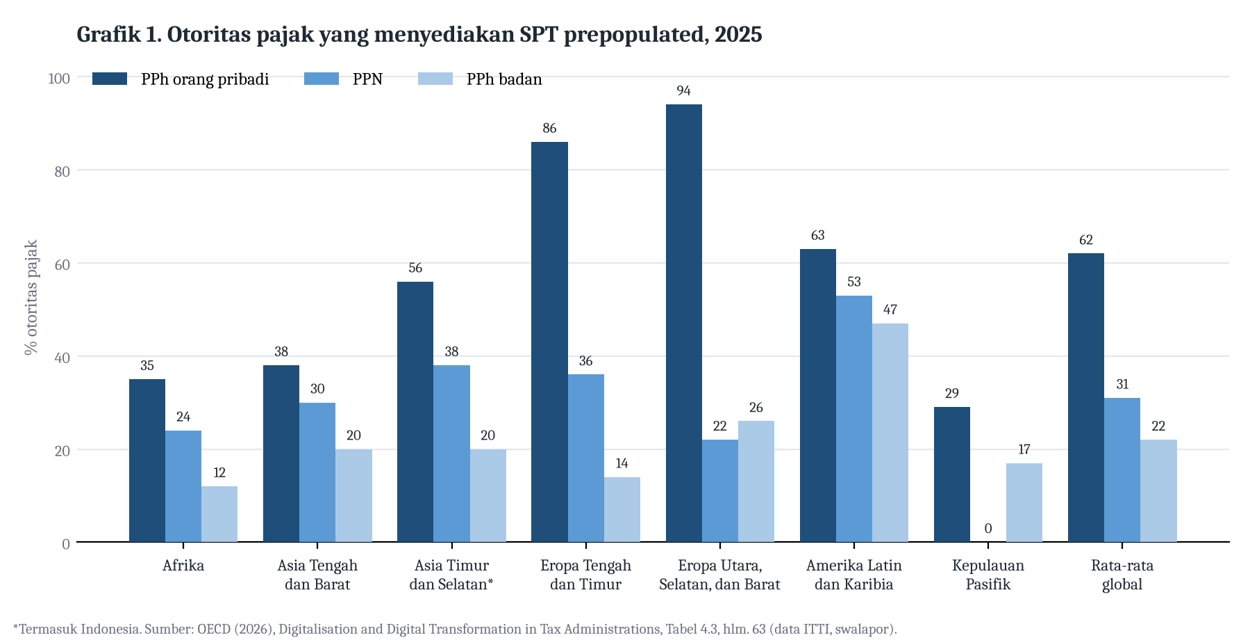
Globally, 62% of tax authorities already provide pre-populated individual income tax returns. This figure is well above pre-populated VAT returns, offered by only 31% of authorities and pre-populated corporate income tax returns at just 22% (see chart 1).
Europe is the most advanced region for individual income tax returns. As many as 94% of tax authorities in Northern, Southern, and Western Europe and 86% in Central and Eastern Europe have already implemented the pre-populated scheme. Meanwhile, Latin America and the Caribbean lead in VAT and corporate income tax, with 53% of authorities providing pre-populated VAT returns and 47% for corporate income tax returns.
In the East and South Asia region, 56% of authorities provide pre-populated individual income tax returns, slightly below the global average. However, for VAT returns, the region records 38%, above the global average of 31%. For corporate income tax returns, the figure stands at 20%.
Income Data Most Commonly Pre-filled
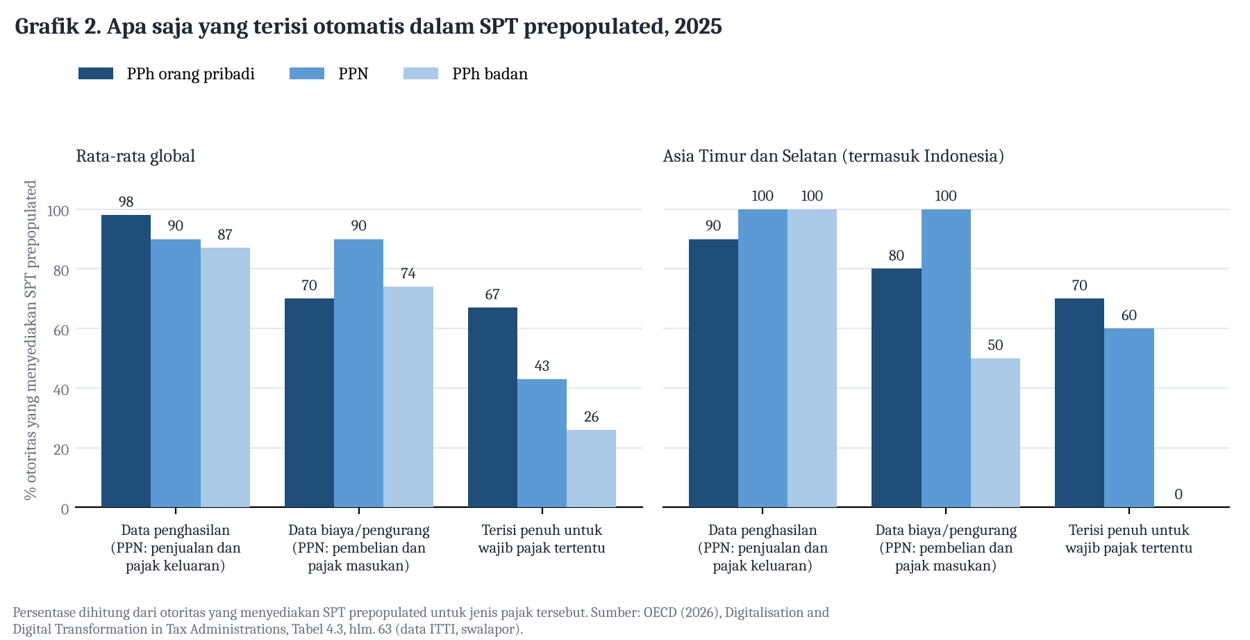
So what data is automatically pre-filled? Of authorities that already provide pre-populated individual income tax returns, 98% automatically pre-fill income data. However, only 70% also automatically pre-fill expense or income deduction data (see chart 2).
A similar pattern is seen for corporate income tax returns. Of authorities providing pre-populated corporate income tax returns, 87% pre-fill income data and 74% pre-fill expense data. For VAT returns, 90% of authorities automatically pre-fill sales data and output VAT, and 90% also pre-fill purchase data and input VAT.
Moreover, some authorities have already pre-filled returns in full for certain groups of taxpayers, meaning those taxpayers do not need to alter the contents at all. For individual income tax returns, this is done by 67% of authorities providing pre-populated returns. The proportion drops to 43% for VAT returns and just 26% for corporate income tax returns.
In the East and South Asia region, 70% of authorities providing pre-populated individual income tax returns have already pre-filled them in full for certain groups, whilst for VAT returns the figure is 60%. However, no authority in this region has yet fully pre-filled corporate income tax returns. By comparison, in Northern, Southern and Western Europe, fully pre-filled individual income tax returns reach 88%.
Government and Banking Data as Primary Sources
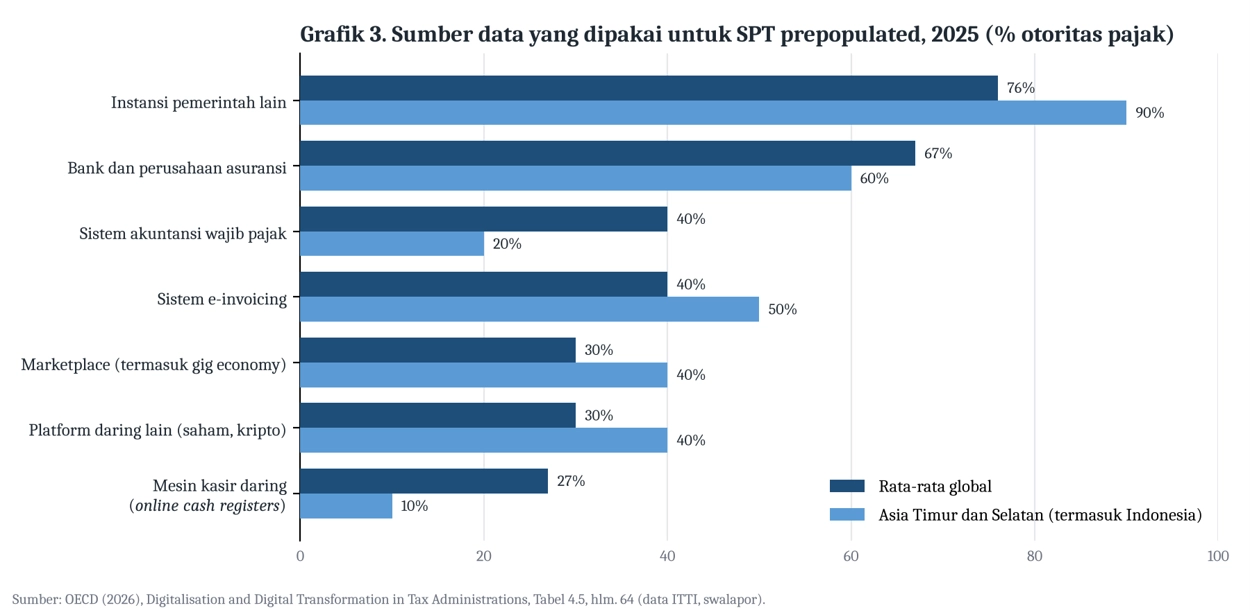
How far a return can be automatically pre-filled depends on the electronic data available to the tax authority. According to the OECD report, other government agencies are the most common source of pre-populated data, used by 76% of authorities. Banks and insurance companies come next at 67% (see chart 3).
Taxpayer accounting systems and e-invoicing systems are each used by 40% of authorities. E-invoicing data is a key source in Latin America and the Caribbean (82%) and Central and Western Asia (75%). Data from marketplaces, other online platforms, such as share and crypto trading and online cash registers, are relatively less commonly used.
In the East and South Asia region, 90% of authorities utilise data from other government agencies for pre-populated returns. E-invoicing data is used by 50% of authorities in this region, whilst marketplace data and other online platforms are each used by 40%, higher than the global average.
The OECD report also includes several examples of e-invoicing consumption for pre-populated returns. Chile, for instance, has since 2017 provided automatically generated proposed monthly VAT returns derived from electronic invoice-based books of accounts for purchases and sales. Kenya, through eTIMS, uses invoice data to automatically pre-fill VAT returns. Malaysia is also upgrading its MyInvois system to support pre-populated returns.
Rules Also Simplified
The pre-populated scheme is not solely a matter of technology. The OECD report notes that 46% of jurisdictions have simplified their tax rules so that returns can be automatically pre-filled with all the necessary data. This step has been taken most frequently in Latin America and the Caribbean (67%), whilst in East and South Asia the figure is 43%.
Of jurisdictions that have simplified their rules, 57% have reduced or simplified the types of deductions and allowances. Meanwhile, 52% have established special tax regimes with simpler income calculations.
For Indonesia, these findings are relevant to the implementation of Coretax. In the same report, the OECD notes that Coretax supports automatic tax calculation and pre-populated data, and aligns the taxpayer identification number (TIN) with the national identification number (nomor induk kependudukan/NIK in Indonesian) for resident individual taxpayers, thereby facilitating integration with third-party data.
“Significantly improving efficiency and reducing human error. The filing of various taxes, such as individual and corporate income taxes, VAT and luxury goods sales tax, withholding taxes, land and building tax, and stamp duty, is integrated within a single system,” the OECD report states.
One point to note is that the pre-populated scheme does not eliminate the taxpayer's role. Taxpayers still need to review, confirm or correct the data before filing the return. Coretax does allow taxpayers to delete withholding receipts from the draft return, but that data remains stored in the DGT's system and may be used for compliance monitoring.
For taxpayers who have received the email blast, the DGT states that amending the 2025 annual income tax return and settling any tax underpayment by 31 December 2026 at the latest may entitle them to a 100% reduction in administrative penalties. As a note, data in the OECD report is self-reported by each respective tax authority and has not been validated by the OECD. (kaw)