



ALP and GFA: Two Approaches to Multinational Group Profit Allocation
SINGAPORE, DDTCNews – Transfer pricing in transactions between companies belonging to the same multinational group is not solely concerned with how the price of goods or services is assessed.
From a taxation perspective, the matter also involves how taxable profits are allocated to each entity and jurisdiction.
This was conveyed by Raffaele Petruzzi, Managing Director of the WU Transfer Pricing Center at the Institute for Austrian and International Tax Law at WU (Vienna University of Economics and Business), during a session of the WU-TA Advanced Transfer Pricing Programme 2026 in Singapore.
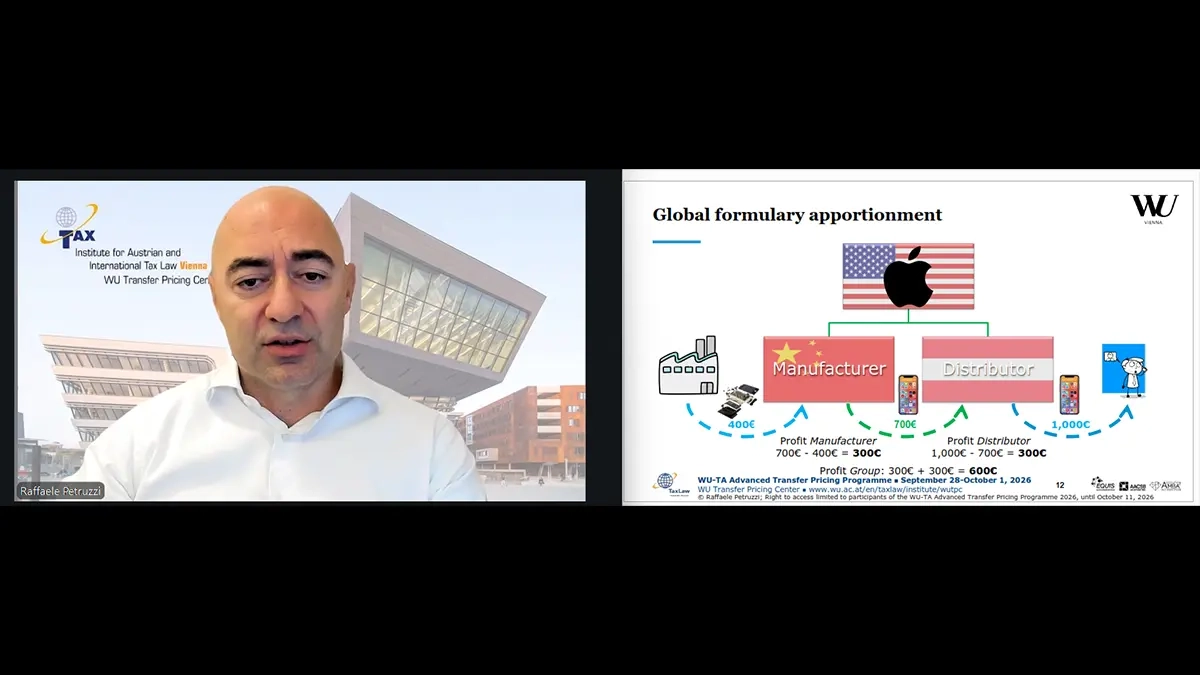
Petruzzi invited participants to examine the difference in perspectives between accounting and taxation when determining the price of intra-group transactions. To illustrate this, he used a simple example involving a multinational group that manufactures and distributes mobile phones.
In the illustration, a manufacturing company in China purchases all mobile phone components from third parties for EUR400. Once produced, the mobile phones are sold to a distributor at EUR700.
The distributor then sells the mobile phones to consumers in Austria for EUR1,000. Accordingly, the manufacturing company earns a profit of EUR300 and the distributor also records a profit of EUR300. Overall, the group's profit amounts to EUR600.
From an accounting perspective, Petruzzi explained that one of the key questions is what price should be set in the transaction between the manufacturer and the distributor.
One approach that can be used is the Cost Plus method. Under this approach, production costs are first calculated and remuneration or profit for the manufacturing company is then added to arrive at the transfer price.
In the illustration, this mechanism produces a transfer price of EUR700. However, Petruzzi highlighted that the question changes when the same transaction is viewed from a taxation perspective.
“However, from a tax perspective, the question that arises is how much taxable profit the manufacturing company and the distributor have each earned, and whether that amount of taxable profit is appropriate,” he said.
Thus, the matter does not end at the EUR700 price recorded in the transaction. Tax authorities also have an interest in ensuring whether the EUR300 taxable profit arising at each company accurately reflects the proper profit allocation.
Petruzzi noted that tax policymakers are concerned about the flexibility companies have in determining transaction prices and profits between entities within a single group.
“From a tax perspective, policymakers in various countries do not simply trust accounting records,” he said.
This is because the price set in intra-group transactions ultimately determines what share of profit arises at each entity and, in a cross-border context, the jurisdiction in which that profit is taxed.
According to Petruzzi, policymakers have sought to establish stricter mechanisms for determining taxable profit whilst also limiting the possibility of profit shifting between countries.
“For this reason, over many years, policymakers have sought solutions to tighten these rules for the taxable profit to be determined in a manner that prevents the manufacturing company from shifting profits out of China or the distributor from shifting profits out of its jurisdiction,” he explained.
Differences Between the ALP and GFA Approaches
This issue then leads the discussion to the two approaches to allocating multinational group profits: the Arm's Length Principle (ALP) and Global Formulary Apportionment (GFA).
Under the ALP, the arm's length nature of transactions between related parties is essentially assessed by comparing them with conditions that would occur between independent parties.
Returning to Petruzzi's illustration, the transfer price of EUR700 between the manufacturer in China and the distributor in Austria must be tested to determine whether it reflects the arm's length principle (ALP).
That analysis takes into account, among other things, the functions performed, the assets used and the risks borne by each entity. Attention is therefore given to how profits should be allocated among entities within a group.
In contrast to the ALP, GFA employs a more aggregated approach. Under this approach, the group's global profit is first determined. That profit is then allocated to each jurisdiction based on a specified formula.
The formula may take into account economic factors, such as sales, assets, labour or a combination of several factors.
Using the same illustration, the group's profit of EUR600 is not determined through the setting of the transaction price between the manufacturing company and the distributor. Instead, that profit becomes the base which is subsequently allocated between China and Austria in accordance with the predetermined formula.
This difference highlights the principal character of each approach. The ALP proceeds from the transactions and economic relationships between entities within a group, whereas GFA proceeds from the group's overall profit and then allocates it based on specified factors.
Report from Singapore
For information, this report was written by DDTC Consulting Specialist Ngurah Bagus Pembayun Kepakisan, who is attending the WU-TA Advanced Transfer Pricing Programme 2026 in Singapore. The programme is held from 28 September to 1 October 2026.

In addition to Bagus, 5 other DDTC professionals are participating in the programme. The participation of these professionals in the training forms part of the Human Resource Development Programme (HRDP) run by DDTC.
Through this programme, DDTC provides its professionals with the opportunity to develop their competencies via various training programmes, both domestically and abroad. All costs associated with participation in this programme are borne by DDTC with no service bond attached.
DDTC Founder, Darussalam, who is also one of Indonesia's leading tax experts, stated that the participation of DDTC professionals in the programme is aimed at strengthening their understanding of developments and practices in international transfer pricing.
In his view, the knowledge and perspectives gained from this international training can support DDTC professionals in handling a wide range of transfer pricing issues and in providing services and advisory to clients to a standard that exceeds expectations.
Participation in the international training programme also forms part of DDTC's commitment to continually investing in its human resources. This investment is carried out through various competency development programmes, including professional training and the provision of scholarships for study at leading universities across the globe.
This commitment is aligned with DDTC's vision of becoming a tax institution grounded in research, technology, and knowledge that sets the standards and beyond. (rig)