



The Importance of Mapping Tax Aspects and Risks in Securitisation
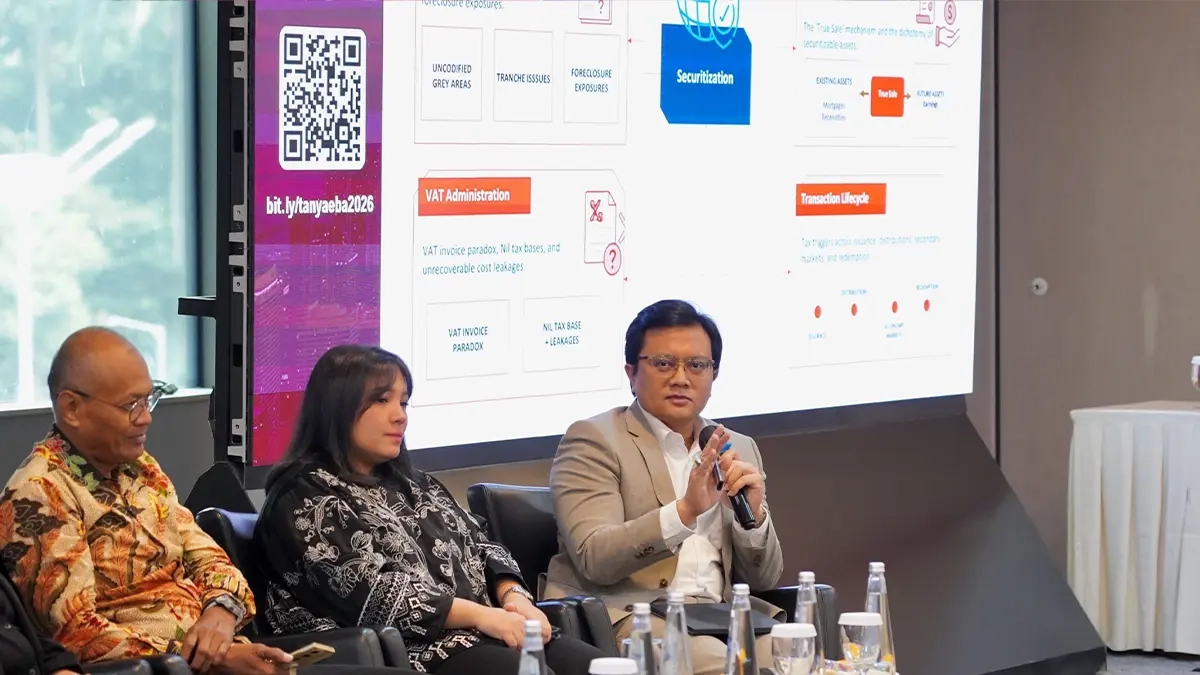
JAKARTA, DDTCNews - The execution of securitisation through a Collective Investment Contract–Asset-Backed Securities (CIC-ABS) or Asset-Backed Securities in the form of Participation Notes (ABS-SP) requires careful attention to various tax consequences and risks from the outset of transaction design.
Managing Partner of DDTC Consulting, David Hamzah Damian, takes the view that, in general, the structure or framework of securitisation, including CIC-ABS and ABS-SP, must be designed by aligning commercial substance, legal form, accounting treatment and tax consequences.
"As tax consultants, we try to think through the entire securitisation cycle, right through to its tax implications. This is important so that everything is aligned, including the commercial, accounting, legal, and tax aspects," he said at the Asset-Backed Securities Forum 2026 at the Indonesia Stock Exchange (IDX) on Tuesday (1/9/2026).
According to David, the commercial, accounting, legal and tax aspects must be mutually supportive and consistent from the very start of designing a securitisation transaction. As such, the tax consequences and risks at each stage can be identified.
These stages range from asset transfer, issuance of investment vehicles, payment of returns, trading on the secondary market, through to the mechanism for closing the securitisation transaction, namely redemption and dissolution.
"From a tax perspective, we must think ahead all the way to the dissolution stage, i.e., how the redemption works, because this will affect all other aspects," said David.
David also explained several tax risks that require attention in securitisation transactions, including those involving CIC-ABS and ABS-SP, along with the corresponding mitigation measures.
There are a minimum of 6 risks to be aware of. First, the risk of income tax being imposed upon the transfer of the securitised assets. Second, the risk relating to the valuation of the securitised asset transfer, which may have implications for the imposition of Article 23 Income Tax.
Third, the risk arising from a regulatory gap between CIC-ABS and ABS-SP. The provisions on CIC-ABS have been stipulated under the Director General of Taxes Decree KEP-147/PJ/2003. Meanwhile, no written regulations exist for ABS-SP, implying that in practice, the tax treatment of ABS-SP is assumed to be the same as that of CIC-ABS.
"When there is no written regulation, we treat the tax treatment as being the same. Practitioners assume that the Directorate General of Taxes (DGT) will treat ABS-SP in the same manner as CIC-ABS on the basis of commercial equivalence; and this is an interpretation risk, given the absence of any standardised written rules," said David.
Fourth, the risk relating to the characterisation of cash flows between Class A (senior tranche) and Class B (junior tranche). This is because the tax treatment will be based on the legal characterisation of those cash flows (tranches).
Fifth, the risk of VAT administration. In securitisation, the transfer of securities and financing services is exempt from VAT. However, where the party conducting the transaction is a taxable person, an obligation to issue a tax invoice remains.
Sixth, the risk of unrecoverable input VAT leakage. Services provided by parties such as investment managers, custodian banks, auditors and rating agencies give rise to input VAT of 11%.
Given that a CIC-ABS generates nil output VAT by virtue of the VAT exemption facility it receives, the input VAT is non-creditable. This results in input VAT being part of the operating expenses, which may ultimately affect the yield for investors. (rig)