



VAT Incentives for Staples to Education Reach IDR213 Trillion
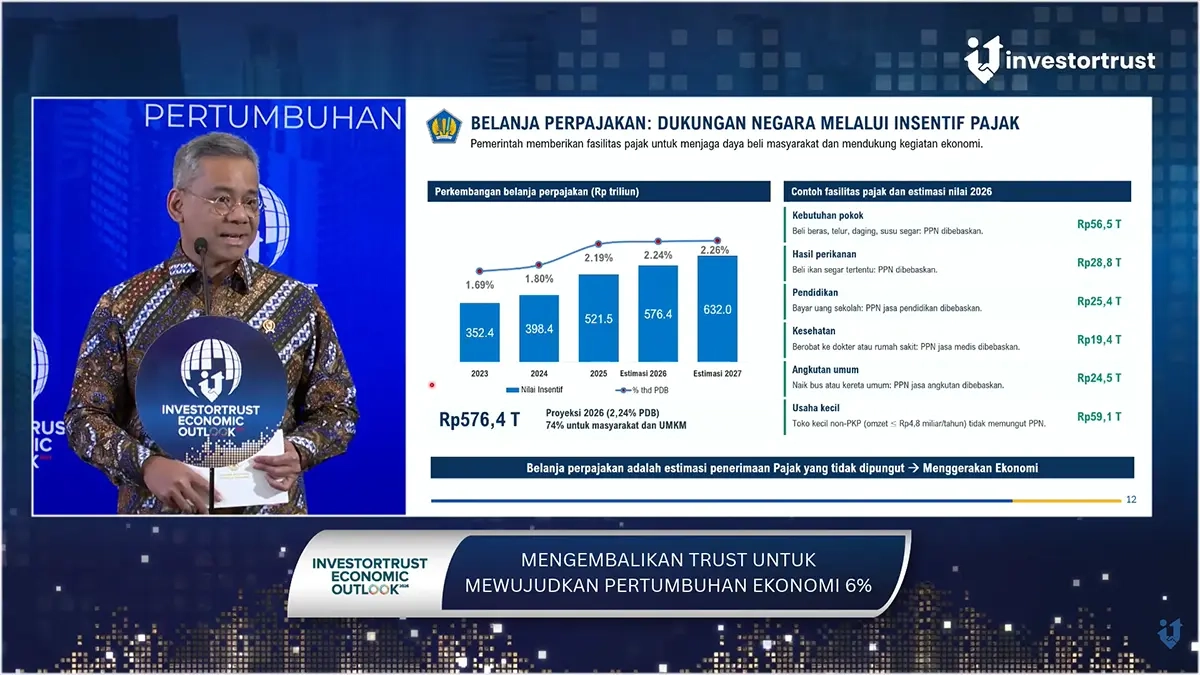
JAKARTA, DDTCNews - Tax expenditure from various VAT facilities covering basic necessities, education, fishery products, and healthcare services is estimated to reach IDR213.7 trillion in 2026.
Minister of Finance, Suahasil Nazara, said that tax expenditure represents a form of government support through tax revenue that is not collected. In his view, uncollected tax revenue can be recycled to stimulate the economy.
"We continue to track how much tax revenue the state does not collect. What is not collected? Quite a lot, for example, various strategic products that are not subject to VAT," he said at the Investortrust Economic Outlook 2027, Tuesday (24/11/2026).
Suahasil stated that tax expenditure for fiscal year 2026 is estimated at IDR576.4 trillion. Of that amount, tax expenditure relating to VAT facilities on strategic products is estimated to reach IDR213.7 trillion.
He cited examples of basic necessities such as rice, eggs, meat and fresh milk that benefit from VAT exemption facilities. Tax expenditure from those facilities is estimated to reach IDR56.5 trillion in 2026.
In the fisheries sector, the government also provides the VAT exemption facility for certain types of fresh fish, with tax expenditure estimated at IDR28.8 trillion.
The government also provides the VAT exemption facility for education services, with tax expenditure estimated to reach IDR25.4 trillion. Meanwhile, tax expenditure from the VAT exemption facility for medical services is estimated to reach IDR19.4 trillion.
The government likewise provides e VAT exemption facilityfor transport services, such as buses and trains. Tax expenditure from those facilities is estimated to reach IDR24.5 trillion.
In addition, the Ministry of Finance notes that there is the non-collection of VAT non-collection facility for small shops or businesses that are not taxable persons (pengusaha kena pajak/PKP in Indonesian). Tax expenditure from those facilities is estimated to reach IDR59.1 trillion.
Beyond VAT facilities, Suahasil said the government also provides other tax facilities to encourage business activity. Examples include a final income tax rate of 0.5% for micro, small and medium enterprises (MSMEs) and a 0% import duty tariff for certain industries.
"Indonesia undertakes tax expenditure. In principle, the tax regulations allow collection, but the government deliberately introduces separate regulations to forgo collecting that tax, making it a form of incentive," said Suahasil.
According to Suahasil, tax revenue that the government does not collect remains in circulation within society. This gives households and businesses greater scope for consumption or investment, which is expected to stimulate the domestic economy.
"If [tax] is not collected, that money remains in the hands of the public. It is then recycled by the public into consumption and investment, without passing through the State Budget or Local Government Budget. Our approach is to provide it through facilities and incentives," he explained.
Tax expenditure itself arises from tax revenue that is not collected owing to deviations from general tax provisions. The movement in the value of tax expenditure also reflects the dynamics of economic activity.
Suahasil also highlighted the tax ratio target of 10.4% for 2026. He noted that, in theory, the tax ratio could reach 12.2% if the government did not provide tax incentives, allowing previously uncollected tax revenue to flow into the state treasury.
"When our tax ratio is said to be 10-point-something per cent, the state could, in fact, collect up to 12.2%, but 2.2% of that represents tax that is not collected," he said. (rig)