



Institut STIAMI Visits DDTC to Discuss Tax Education Vision
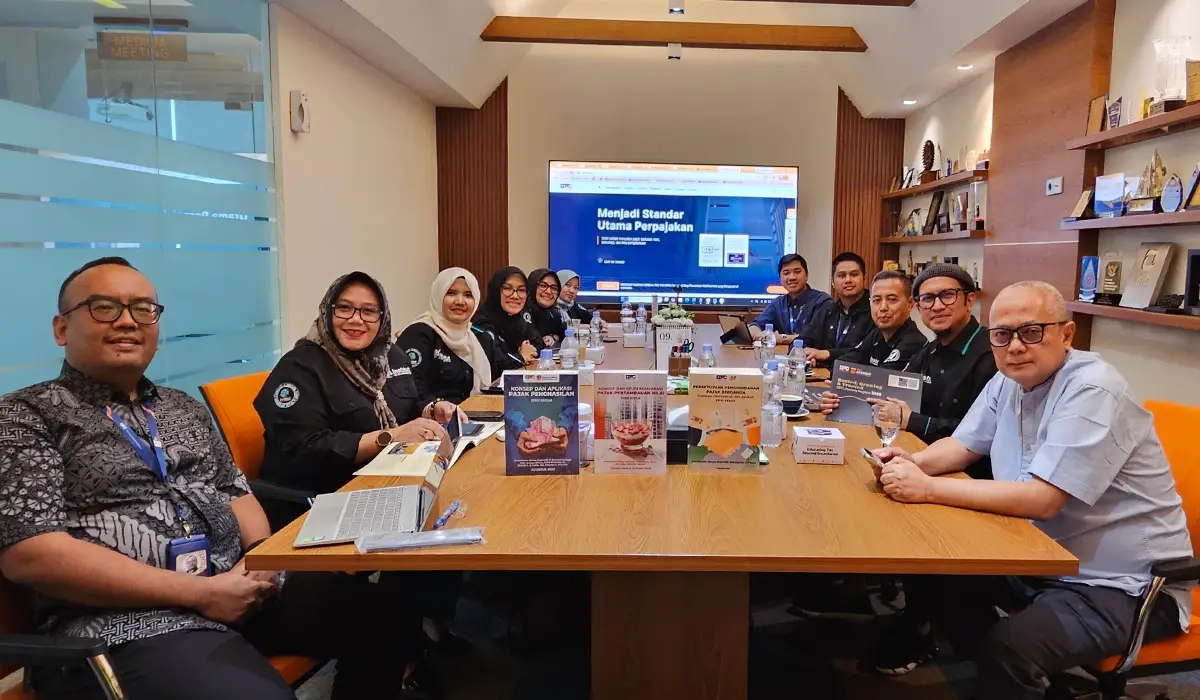
JAKARTA, DDTCNews - A delegation from Institut STIAMI visited Menara DDTC today, Tuesday (8/9/2026). They held discussions on the development of tax education in Indonesia.
Institut STIAMI and DDTC exchanged views on the vision for developing tax education, covering curriculum design, competency standards, professional developments and the role of higher education institutions in supporting the construction of Indonesia's tax system.
DDTC Founder Darussalam welcomed the visit and the discussion. In his view, dialogue among stakeholders is necessary to establish a tax education system capable of meeting long-term needs.
“Tax education going forward needs to be built with a broader vision. Not merely preparing students to understand regulations or enter the professional world, but forming human resources who can understand taxation in a multidisciplinary manner, think critically and contribute to the construction of Indonesia's tax system,” he said.
During the discussion, both parties also addressed the importance of maintaining the quality of tax education amid an increasingly dynamic system and profession. Curriculum, teaching quality, practical experience and learning outcomes were among the aspects identified as requiring continuous development.
According to Darussalam, taxation is a multidisciplinary field that intersects with law, accounting, economics, administration, public policy and developments in business and technology. Tax education must, therefore, provide a strong academic foundation whilst also building analytical skills and critical thinking.
“Tax education should be the ‘host’ of the tax profession's ecosystem. That position must, of course, be underpinned by continuously strengthened educational quality, ranging from curriculum and teaching standards to practical experience to graduate competency standards,” he remarked.
Developments in professional regulation also formed part of the discussion. The issuance of MoF Reg. 44/2026 and MoF Reg. 55/2026 has renewed discourse on the position of formal education in building competency within the tax profession.
Darussalam holds the view that such discourse should not stop at the question of recognition of education, which has in fact already been accorded a place in law. What also needs to be discussed is how tax education can continuously improve its quality so that the competencies developed through higher education institutions have clear standards.
“That is where higher education institutions, the professional world, the government and other stakeholders need to establish a shared vision,” he said.
Regardless of regulatory developments, Institut STIAMI and DDTC share the view that tax education has a broader scope. Higher education institutions also have a role in the development of knowledge, research and ideas that can contribute to the improvement of the tax system.
Darussalam has on a previous occasion noted that, ideally, universities can help build a tax system that is legally certain, fair and equitable, whilst also serving as a constructive critical partner for the tax authority.
The Institut STIAMI delegation in attendance included Director of Postgraduate Studies, Diana Prihadini, Dean of the Faculty of Administrative Science, Dwi Agustina, Executive Master's Programme Coordinator, Roike Tambengi, Head of the Business Accounting Programme Citra Novlyani, Head of the Cakung Campus, Suparman, Lecturer Pebriana Arimbhi and Marketing Coordinator, Anike Suci.
Institut STIAMI expressed its commitment to strengthening the collaboration that has been established with DDTC. Future cooperation is expected not only to continue but also to grow through various programmes that benefit students, lecturers, and the development of tax education.
“The collaboration between Institut STIAMI and DDTC has been running well. Going forward, we wish to further strengthen and develop this collaboration through various joint programmes that we can work on together,” said Director of Postgraduate Studies Diana Prihadini.
There are various programme options that can be explored, ranging from curriculum development, public lectures and guest lectures, practitioner involvement in apprenticeship, internship programmes, joint research and publications, through to competency-enhancement activities for students.
“We observe many areas that can be jointly developed. We hope that in the foreseeable future, we will be able to run several programmes," said Executive Master's Programme Coordinator Roike Tambengi.
The dialogue also formed part of DDTC's ongoing efforts to allow collaboration with higher education institutions. To date, DDTC has established educational partnerships with 40 higher education institutions in Indonesia.
DDTC has collaborated with various higher education institutions on curriculum development, public lectures, research, internship programmes and human resource capacity building.
Through such collaboration, DDTC endeavours to contribute to building a tax education ecosystem with a robust academic foundation, relevant to current developments and capable of producing human resources who can contribute to Indonesia's tax system. (kaw)