



Preventing Pragmatism: Tax Education Must Be a Priority
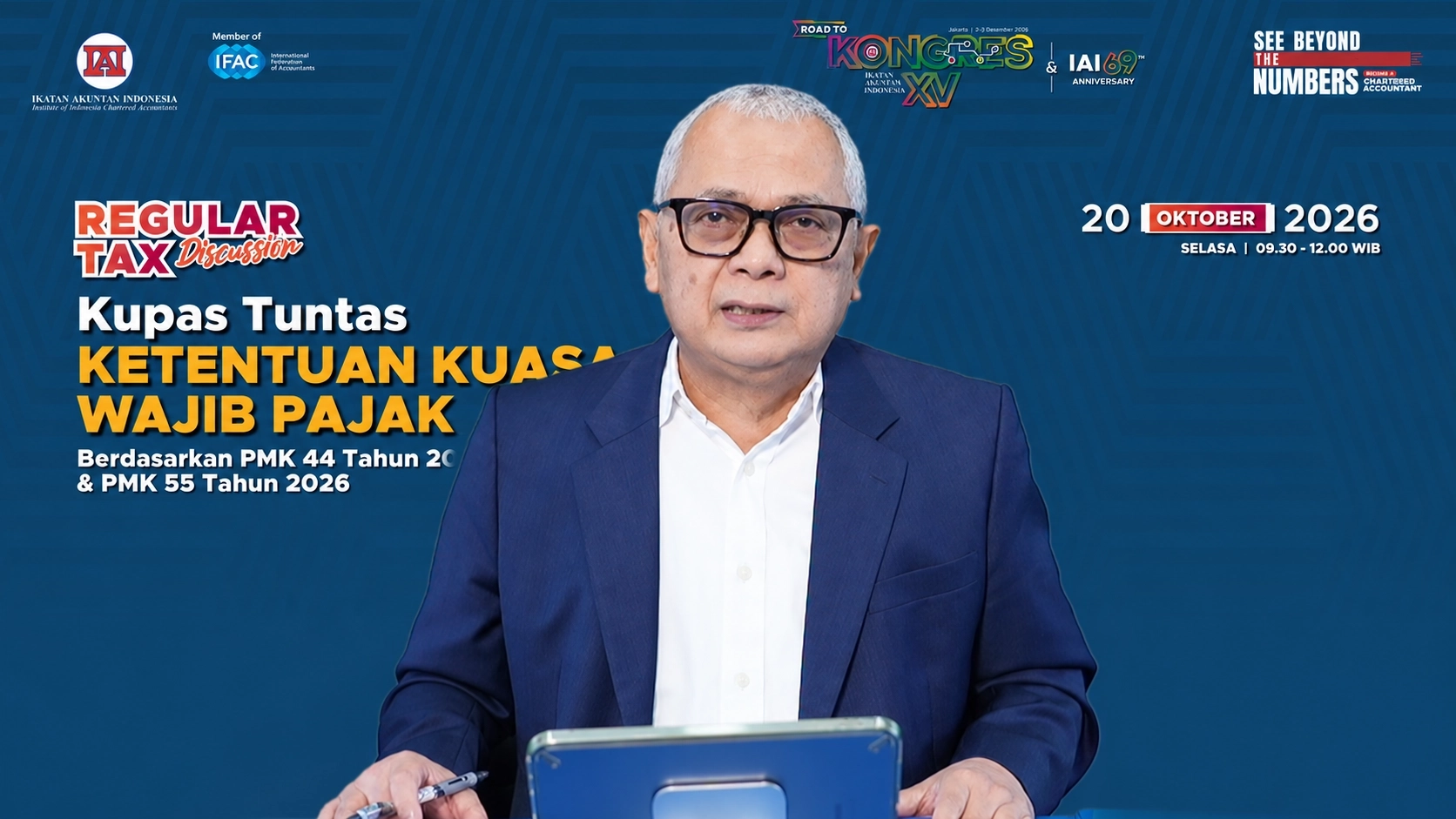
JAKARTA, DDTCNews - DDTC Founder, Darussalam, has urged all parties to avoid studying tax in a purely pragmatic manner, whilst promoting the establishment of an ecosystem for tax competency education.
Darussalam stated that tax should not merely be studied pragmatically through practice questions alone, but substantively and progressively, by fostering a deeper understanding of concepts, international perspectives and theory.
"All parties have an equal obligation to build a tax competency education system whose competencies can be genuinely assessed. Studying tax to obtain tax competency should not be through a one-off examination, but through a step-by-step process conducted via a tiered pathway," said Darussalam at a regular tax discussion organised by the Institute of Indonesia Chartered Accountants (Ikatan Akuntan Indonesia/IAI in Indonesian) on Tuesday (20/10/2026).
Nevertheless, the provisions concerning proof of tax competency actually close the door for parties wishing to use a university degree as evidence of tax competency. With the introduction of MoF Reg. 44/2026 and MoF Reg. 55/2026, tax competency can now only be demonstrated through a competency examination alone.
The closing off of avenues for holders of taxation degrees to have their competency in the field of taxation recognised, and the provision of a competency examination as the sole means of proving competency, raises concerns that such pragmatism will take hold.
"We must not allow what we are doing here to create a new perception that one need not attend school or undertake tax education to become a tax attorney. What I fear is the emergence of a phenomenon of studying tax pragmatically simply to pass a competency examination. This is what we must avoid," said Darussalam.
Darussalam stated that a disregard for tax education among all parties would foster pragmatism, an attitude that prioritises instant results, and would prevent the establishment of a national character that is compliant with tax regulations.
According to Darussalam, education should remain the driving force behind the formation of national character. The professions of tax attorneys and tax consultants should likewise continue to pay attention to and embrace the world of education.
"National education serves to develop capability, and, far more importantly, to build national character. In the context of tax, this means building a national character that is compliant with tax regulations. This is where the importance of education lies, in how character is built," said Darussalam.
Aligning Competency Verification
Under the currently applicable MoF Reg. 44/2026 and MoF Reg. 55/2026, a person may only become a taxpayers' attorney after passing through the single gateway provided by the government, namely a competency examination administered by the Financial Education and Training Agency (Badan Pendidikan dan Pelatihan Keuangan/BPPK in Indonesian).
The provisions under those ministerial regulations differ from Article 32 paragraph (3a) of the General Provisions and Tax Procedures (GPTP) Law, which provides three gateways for demonstrating competency, namely specific education, certification and/or guidance by an association or the Ministry of Finance (MoF).
"MoF Reg. 44/2026 and MoF Reg. 55/2026 move from the three gateways opened by the GPTP Law to a single gateway," said Darussalam.
In contrast to MoF Reg. 44/2026 and MoF Reg. 55/2026, which require a person to pass a tax competency examination to act as a taxpayer attorney, the provisions applicable at the Tax Court actually permit parties to use a taxation education degree as evidence of tax competency.
With the application of the hold-harmless and soft-landing principles during the process of consolidating the Tax Court under a single roof, the requirements for legal attorneys at the Tax Court under MoF Reg. 184/2017 have been declared to remain in force.
Under that ministerial regulation, a person may act as a tax legal attorney at the Tax Court provided they possess extensive knowledge in the field of tax, as evidenced by a Bachelor's degree (S-1/D-IV) in fiscal administration, accounting, and/or taxation.
"In terms of legal attorneys, they apply the soft-landing and hold-harmless principles. They are aware that we are currently still in a transitional period prior to the consolidation under a single roof, and they continue to keep the door open for taxation education degrees. In fact, the taxation education degree pathway also exists under the GPTP Law," said Darussalam.
The difference in the mechanisms for proving tax competency for taxpayers' attorneys and legal attorneys as described above reflects a misalignment in the regulation of representation. Taxpayers' attorneys and legal attorneys are in fact underpinned by the same competency. However, the means of proving that competency is regulated differently.
To resolve this issue, Darussalam advocates collaboration among stakeholders to achieve uniformity in the mechanism for proving competency in the field of taxation.
"Going forward, we can work together to formulate these two regulations with the same competency and the same competency examination. We must not allow a situation where the competency is the same, but the assessment tools for attaining that competency differ. This is what is currently happening in Indonesia," said Darussalam.
According to Darussalam, the structuring of competency for taxpayer representatives and tax legal representatives at the Tax Court needs to be grounded in the Indonesian National Qualifications Framework (Kerangka Kualifikasi Nasional Indonesia/KKNI in Indonesian), a framework for the tiered classification of the competency of Indonesian human resources that aligns, equates and integrates the education sector with the training and work experience sector within a single scheme for recognising work capability.
"What is the appropriate gateway for a person seeking to enter the ecosystem of the taxpayer representative profession and the tax consultant profession? Here we connect this to the KKNI. In my view, there should be three pathways established for entry into this profession," said Darussalam.
The available pathways are as follows: first, a priority pathway for graduates of higher education institutions in the field of basic tax competency who are recommended upon fulfilling the required standards, without the need to sit a basic competency certification examination.
Second, an equivalence or certification pathway for graduates from fields outside basic tax competency (both legal and non-legal), as well as graduates from higher education institutions that do not yet satisfy the standards of the priority pathway.
Third, a recognition or accreditation pathway for individuals whose expertise has been proven, such as retired tax authority officials, practitioners, researchers and academics, subject to specific qualification, length of service and/or experience requirements. (dik)