



DGT Reveals Dominant Tax Dispute Patterns in Court
JAKARTA, DDTCNews - The Directorate General of Taxes (DGT) has recorded that the majority of tax disputes between taxpayers and the tax authority in recent years continue to revolve around issues of nexus assessment.
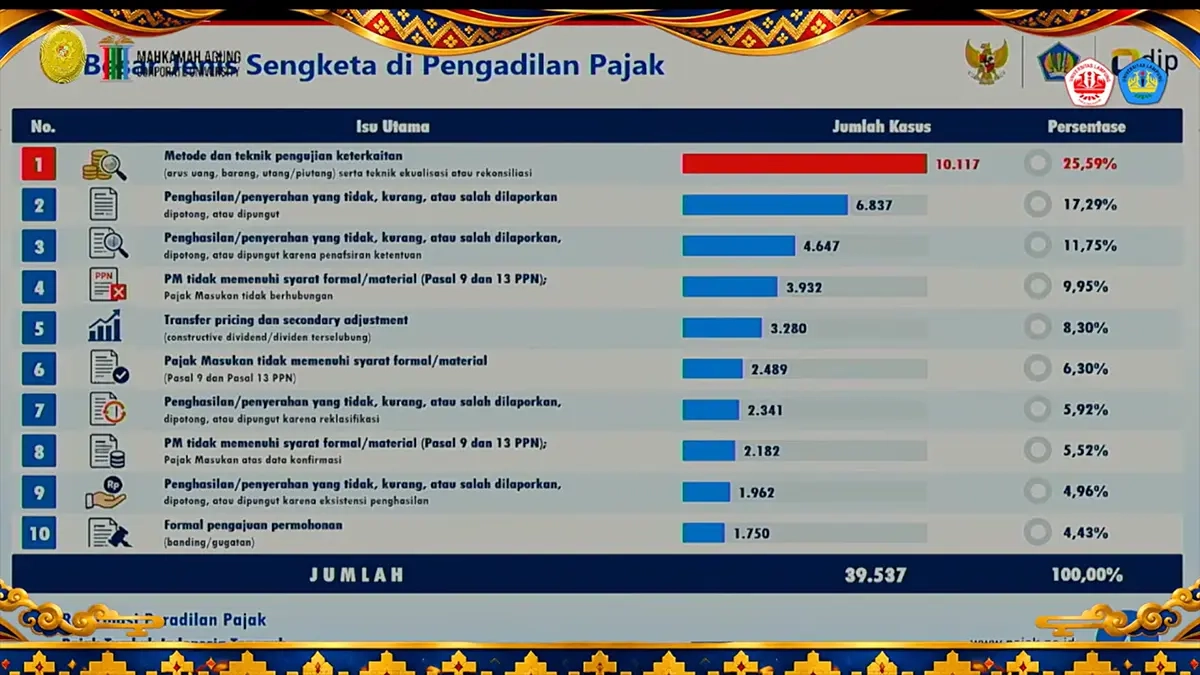
Director General of Taxes, Bimo Wijayanto, stated that out of a total of 39,537 disputes at the tax court between 2021 and Q3/2026, some 10,117 disputes, or 25.59%, related to audit methods and techniques, including equalisation and reconciliation techniques.
"The primary category is methods and techniques for nexus assessment. This requires methodology to scrutinise bookkeeping, supporting evidence for the bookkeeping, technical bookkeeping, accounting standards and reconciliation from accounting to taxation. That is the majority, accounting for 25.59%," said Bimo at a public consultation on the formulation of tax policy recommendations entitled Decentralisation of the Tax Court: Towards an Independent and Accessible Court, Wednesday (4/11/2026).
Further, disputes arising from income or supplies that were not reported, under-reported or incorrectly reported accounted for 17.29% of total disputes.
Meanwhile, disputes arising from income or supplies that were not reported, under-reported or incorrectly reported due to differences in legal interpretation contributed 11.75% of total disputes.
Bimo explained that 9.95% of disputes also arose from the crediting of input VAT that did not fulfil formal or substantive requirements.
These disputes arose primarily because the input VAT had no direct connection to business activities as referred to in Article 9 paragraph (8) of the VAT Law.
"There are indeed many such patterns, not only in the administrative sphere. If mens rea is established, it falls within the domain of tax crimes," said Bimo.
Further, 8.3% of disputes at the tax court arose from differences of opinion regarding transfer pricing and secondary adjustments. "There is a great deal of manipulation involving disguised dividends and expensing here," said Bimo.
On another note, disputes between taxpayers and DGT arise from dissenting opinions regarding tax assessments. Before bringing a dispute to the tax court, a taxpayer must first file an objection with the DGT.
An objection may be filed against a notice of tax assessment (surat ketetapan pajak/SKP) or against the withholding or collection of tax by a third party.
If a taxpayer disagrees with an objection decision letter issued by DGT, the taxpayer may file an appeal to the tax court within a maximum of three months from the date the objection decision letter is received. (rig)