



Testing the ALP and Balancing Payments in a CCA
JAKARTA, DDTCNews - Under a cost contribution arrangement (CCA), several companies within a single group agree to share costs and risks to develop intangible assets, tangible assets or services. However, this scheme raises one important question: are each participant's contributions reasonable and commensurate with the expected benefits?
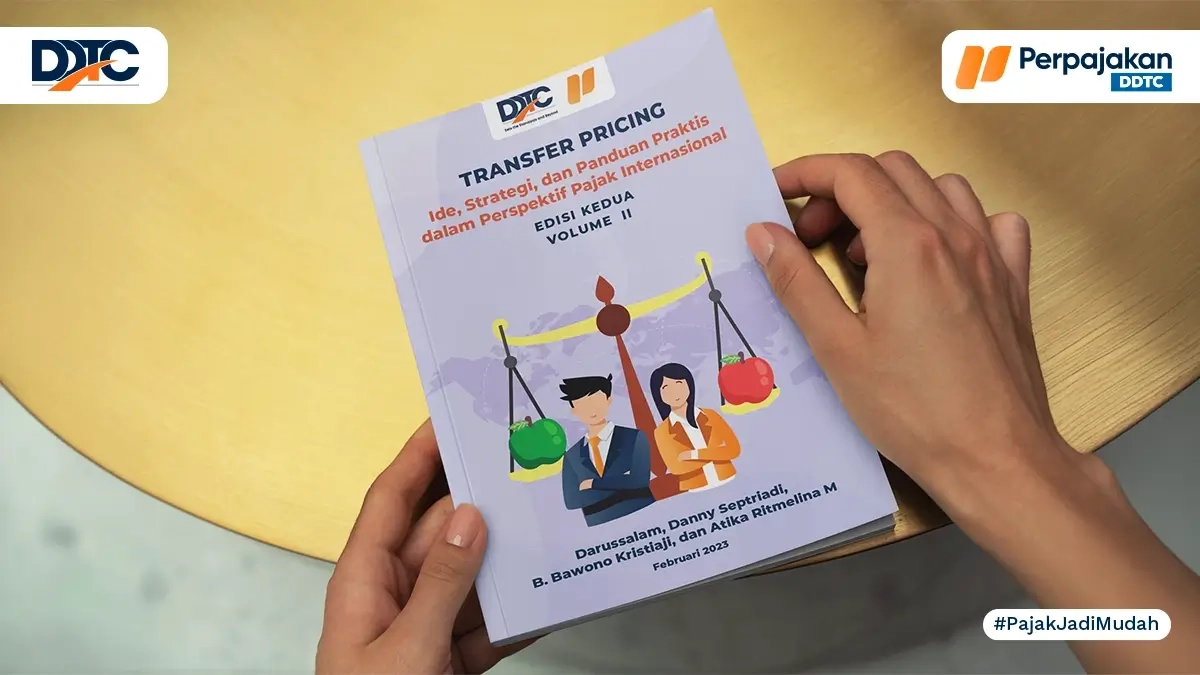
This issue is examined in depth in the book Transfer Pricing: Ide, Strategi, dan Panduan Praktis dalam Perspektif Pajak Internasional (Edisi Kedua - Vol. 2).
According to the OECD Transfer Pricing Guidelines 2022, testing the arm's length principle (ALP) in a CCA is essentially no different from testing it in other intra-group transactions. The analysis begins with accurately identifying and describing the transaction.
This test is based on the hypothetical arm's length test. The premise is that independent companies will only agree to share costs and risks where there is a common need and mutual benefit. Accordingly, each participant's proportion of contributions must align with its proportion of expected benefits.
There are 3 substantive steps in this test. First, an analysis is required to determine whether the participants have an expectation of benefit from the CCA activities.
Second, the value of each participant's contribution must be calculated. Third, an evaluation is required to determine whether the expected benefits are proportionate to the contributions made, with a balancing payment serving as an adjustment where necessary.
One matter that warrants attention is the determination of which parties may be regarded as participants. Under a CCA, a company may only be considered a participant if it has an expectation of benefit from the CCA activities. The company must also have control over certain risks within the CCA activities and the financial capacity to assume those risks.
Where an entity merely carries out certain activities, for example, research functions, but has no expectation of benefit from the results of the CCA, that entity is not treated as a participant. Instead, it is treated as an outsourced service provider for the CCA.
There are 2 approaches to assessing expected benefits. First, the direct basis, whereby benefits are estimated based on the additional income or cost savings that participants are expected to obtain.
Second, the indirect basis, whereby benefits are estimated through a specific allocation key, such as sales, gross profit or operating profit, number of employees or stated capital invested. Where a CCA covers several activities, the use of different allocation bases for each activity may be more appropriate.
As such, what is the tax treatment? When does a balancing payment become a taxable object for the recipient? And how does it relate to withholding tax and tax treaties? Find the complete answers in this book.
This book comprises 14 chapters totalling 550 pages. Its scope covers transfer pricing for special transactions, corporate strategy, procedural and legal aspects, including BEPS Action 13 documentation, audit, objection and appeal, MAP and APA, through to contemporary developments, such as safe harbour rules and transfer pricing issues in developing countries.
This book is authored by Darussalam, Danny Septriadi, B. Bawono Kristiaji and Atika Ritmelina Marhani. This book may serve as a reference for the business community, tax authorities, the tax court, tax consultants and academics.
Interested in adding a transfer pricing reference to your books of accounts shelf? Two packages are available, each containing this book and one tax regulation reference book. Volume II may also be purchased separately.
The packages can be ordered through the Perpajakan ID Store. Delivery of these book packages is also free of charge.
Have inquiries concerning this book? Contact the Perpajakan DDTC WhatsApp Hotline at 0813-8080-4136 (Siska). (rig)